
Quick answer: Money saving challenges work for debt when every dollar you free up is sent to a specific balance the same day. Pick two or three from the list below, set a dollar target, and automate the transfer so the savings never sit in checking and quietly disappear.
Key takeaways
- A challenge only counts if the cash lands on a debt, not in a vague savings pile.
- Stack two or three challenges at once; one big win beats ten half-started ones.
- Do the math first: $100 a month extra on a 24% card saves far more interest than most people expect.
- Start with the highest-rate balance (avalanche) or the smallest (snowball), but start this week.
Here is the math-first view. Say you carry $6,000 on a card at 24% APR and pay $150 a month. That takes roughly 66 months (an estimate) and costs well over $3,500 in interest. Add $100 a month from a challenge and the timeline shrinks by more than two years. That is what these challenges are for.
Ready to pair your savings with a lower rate? You can request free options to lower your interest rate using the form on this page, then let the challenges below do the heavy lifting.
How to Make Money Saving Challenges Actually Pay Down Debt
Most challenges fail for one reason: the money has no destination. Fix that before you start.
- List your balances. Write down each balance, rate and minimum payment. The one-evening debt payoff plan walks you through it.
- Choose a target debt. Use the debt avalanche method to go after the highest rate first, or the snowball to knock out the smallest balance for momentum.
- Automate the transfer. Schedule a weekly or biweekly extra payment so willpower is not required.
- Track it. A visible chart keeps you going. See visual ways to track your payoff.
Pro tip: Keep paying minimums on every debt. Challenge cash is the extra on top, aimed at one balance at a time.
Challenges That Cut Spending Fast
These four attack your biggest flexible categories. Estimated savings are ranges; your results depend on your habits and where you live.
1. The No-Spend Month
For 30 days, spend only on rent or mortgage, utilities, insurance, transportation to work, minimum debt payments and groceries. Skip dining out, shopping, subscriptions and entertainment. Many households free up a few hundred dollars (estimate); send it to your target debt on day 31, or weekly as you go.
2. The Weekend No-Spend
Can’t commit to a full month? Go no-spend Friday evening through Sunday night. Four weekends can still add up to $100 to $300 (estimate) with much less friction.
3. The Pantry and Freezer Challenge
Eat what you already own for two to four weeks, buying only fresh basics like milk and produce. Plan meals around the oldest items first. A pantry challenge guide is coming soon on this site with a full meal-planning method.
4. The Subscription Purge
Pull three months of statements and highlight every recurring charge. Cancel anything you did not use in the past 30 days. Redirect each canceled amount to debt as a standing payment, so a $15 streaming service becomes a $15 weekly or monthly payment on your card.

Cutting a $15 subscription and paying it toward a 24% card beats leaving it in checking every single time.
Savings Challenges You Can Chart and Print
These use a visual tracker, which makes progress feel real. Instead of depositing into savings, you make the payment to your debt.
5. The 52-Week Challenge (Debt Version)
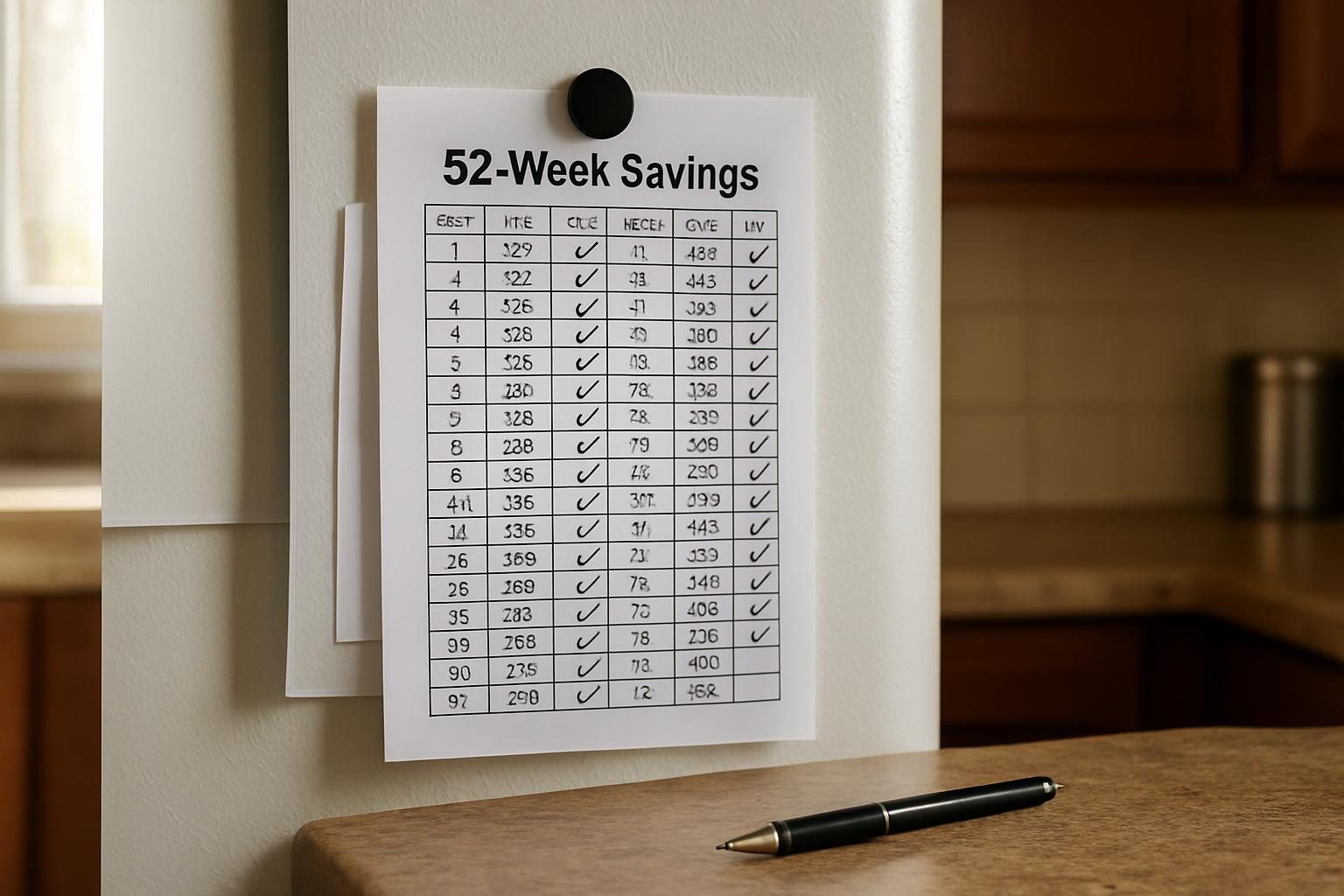
Pay $1 extra in week 1, $2 in week 2, and so on to $52 in week 52. The year totals $1,378. Flip it (start at $52 and shrink) if you want your hardest weeks to come early while motivation is high. Grab the 52-week money challenge chart for debt payoff to track it.
6. The $5 Bill Challenge
Every time a $5 bill lands in your wallet, set it aside. Deposit and send the total to debt at the end of each month. It is slow but nearly painless, and it works best for people who still carry some cash.
7. The Round-Up Challenge
Round every purchase up to the next dollar, or use your bank’s round-up feature, and sweep the difference weekly. For many people this adds $20 to $60 a month (estimate).
8. The Debt Snowflake Challenge
Every time you find a small windfall (a coupon saving, a returned item, a skipped coffee), make an instant micro-payment. Read about the debt snowflake method to see how these tiny payments pile up.
Income-Boosting Money Saving Challenges
Cutting only goes so far. These challenges add dollars rather than just trimming them.
9. The Sell-Ten-Things Challenge
Find ten items you have not used in a year: electronics, tools, furniture, clothes, sports gear. List one per day for ten days. Most households can raise a few hundred dollars (estimate), and the clutter goes too.
10. The Side-Gig Sprint
Commit to one extra shift, delivery run, tutoring session or freelance job per week for 60 days. Decide ahead of time that 100% of the earnings go to debt. Because it is a sprint, not a lifestyle, burnout stays low.
11. The Raise-and-Redirect Challenge
Next time you get a raise, bonus or lower bill, pretend it never happened. Send the full increase to your target debt before your spending adjusts. If a refund shows up in spring, a plan for your tax refund and debt can help you split it wisely.
12. The Rate-Reduction Challenge
This one saves money without changing your lifestyle. Spend one afternoon seeking a lower rate: call your card issuer, compare a 0% balance transfer offer, or look at a consolidation loan. Lowering a rate from 24% to a promotional 0% for a set period means every dollar from your other challenges attacks principal instead of interest. Before moving a balance, read 7 balance transfer mistakes that wipe out your savings and run the numbers in the balance transfer calculator.
Lowering your interest rate is the only challenge where the savings keep arriving long after the effort ends.
How to Combine Challenges Into a Plan
You do not need all twelve. Match them to your situation.
- Tight budget, little to cut: Try the subscription purge, round-ups and the debt snowflake method.
- Reasonable budget, want speed: Combine a no-spend month with a side-gig sprint.
- High-rate card debt: Start with the rate-reduction challenge, then add one spending challenge.
- Slow and steady: Run the 52-week chart plus the $5 bill challenge all year.
Put your numbers into the debt payoff calculator to see how much sooner your debt-free date arrives with each extra dollar. For more ideas, browse the full set of debt payoff challenges. If motivation dips in month two, which is normal, staying motivated while paying off debt has practical fixes.
Common Mistakes That Stall Progress
- Parking the cash. Money left in checking tends to get spent. Pay the debt the same day.
- Skipping the emergency cushion. Without even a small starter fund (many people aim for $500 to $1,000), one surprise bill sends you back to the card.
- Running too many challenges. Three is plenty. Burnout kills more plans than low income does.
- Ignoring the rate. If most of your payment is eaten by interest, a lower rate may help more than another spending cut.
Want to lower your rate while your challenges run? Request your free rate-lowering options with the form on this page, or compare programs on our lower your rate page. Everything here is educational; for personalized advice, talk with a qualified financial professional.
FAQ
How much can money saving challenges really free up?
It varies widely. A realistic range for a typical household running two or three challenges is roughly $100 to $400 a month (an estimate, not a guarantee). The key is applying it to debt immediately.
Should I save the money or pay debt with it?
Build a small starter emergency fund first, then send challenge cash to debt. High-interest balances like credit cards usually cost more than savings accounts earn. For the longer-term question, see pay off debt or invest.
Which challenge is best for beginners?
The subscription purge and the weekend no-spend. Both are quick, low-pressure and give you an early win.
Do these work with student loans, car loans and BNPL?
Yes. Send the extra to the loan’s principal. For student loans, how to make extra student loan payments so they hit principal shows how to tell the servicer where the money should go.
Get free options to lower your interest rate
A partner will share free, no-obligation options so your challenge savings go toward principal, not interest.
