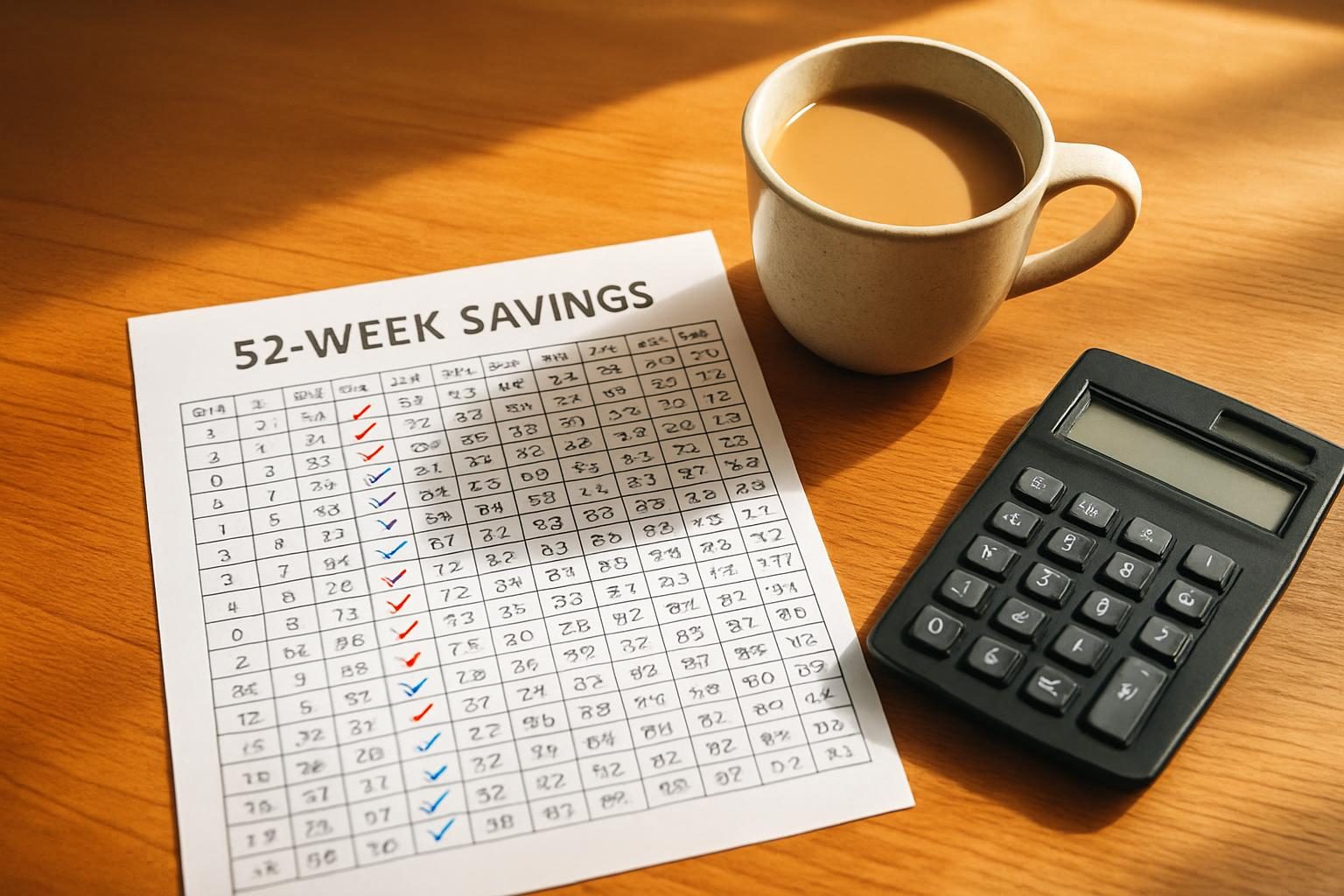
Quick answer: The 52 week money challenge has you set aside $1 in week 1, $2 in week 2, and so on up to $52 in week 52, for a total of $1,378. To use it for debt payoff, skip the savings account and send each week’s amount straight to your highest-priority balance.
Key takeaways
- The classic chart totals $1,378 in a year, and the reverse version totals the same.
- Classic starts easy and ends hard. Reverse starts hard and ends easy, which suits people who fear fading motivation.
- Paying debt instead of saving earns you a guaranteed return equal to your interest rate.
- Combine the challenge with an emergency buffer so a surprise bill does not push you back onto a card.
The 52 week money challenge is one of the simplest money challenges out there, which is exactly why it works. There is no budget to build and no spreadsheet to maintain. This guide gives you the full chart, the reverse version, and a plan for pointing every dollar at debt.
If you would like to pair the challenge with a lower interest rate so more of each payment hits principal, you can request free options to lower your rate using the form on this page.
How the 52 week money challenge works
The idea is a weekly step-up. Each week you set aside a dollar amount equal to the week number.
- Week 1: $1
- Week 26: $26
- Week 52: $52
- Total: $1,378 (the sum of 1 through 52, which is 52 x 53 / 2)
Averaged out, that is about $26.50 a week. The first few months feel almost painless, and by the time the amounts get large you already have a habit built.
The standard version is a savings challenge. In this guide we convert it into a debt challenge, because for most people carrying a credit card balance, paying down debt beats parking cash in savings.

The classic 52-week money challenge chart
Here is the full chart. Print it, tape it to the fridge, and mark off each week as you pay. The running total shows how much you have sent to debt so far.
- Weeks 1-4: $1, $2, $3, $4 (running total: $10)
- Weeks 5-8: $5, $6, $7, $8 (running total: $36)
- Weeks 9-12: $9, $10, $11, $12 (running total: $78)
- Weeks 13-16: $13, $14, $15, $16 (running total: $136)
- Weeks 17-20: $17, $18, $19, $20 (running total: $210)
- Weeks 21-24: $21, $22, $23, $24 (running total: $300)
- Weeks 25-28: $25, $26, $27, $28 (running total: $406)
- Weeks 29-32: $29, $30, $31, $32 (running total: $528)
- Weeks 33-36: $33, $34, $35, $36 (running total: $666)
- Weeks 37-40: $37, $38, $39, $40 (running total: $820)
- Weeks 41-44: $41, $42, $43, $44 (running total: $990)
- Weeks 45-48: $45, $46, $47, $48 (running total: $1,176)
- Weeks 49-52: $49, $50, $51, $52 (running total: $1,378)
Notice that the halfway point (week 26) only totals $351. More than three quarters of the money arrives in the second half of the year. That back-loading is the classic version’s biggest weakness.
The classic chart collects only $351 in six months, then $1,027 in the next six.
The reverse 52-week money challenge
The reverse version flips the order. You start with $52 in week 1, then $51, $50, and so on, finishing with $1 in week 52. The total is the same $1,378.
Why people prefer it:
- Front-loaded progress. By week 26 you have already sent $1,027 to debt, versus $351 in the classic version.
- Less interest. Money applied to a balance earlier cuts the interest that accrues on it, so the reverse order saves slightly more.
- Easier finish. The holiday season, when budgets are tightest, comes with tiny payments.
Why it can fail: big payments up front, while motivation is high but the habit is not yet built, can feel heavy. If a $52 week hurts, you are likelier to quit.
Which version should you pick?
- Choose classic if your income is tight right now or you tend to give up on big goals.
- Choose reverse if you have a little breathing room and want the math advantage.
- Choose a hybrid if you want the middle ground: start at $26, climb to $52, then come back down. Any order that sums to $1,378 works.

How to send your 52 week money challenge dollars to debt
A savings challenge builds a pile of cash. A debt challenge shrinks a balance that is likely costing you 20% or more in interest. Here is how to wire it up:
- List every balance with its interest rate and minimum payment. Our one-evening debt payoff plan walks through this.
- Pick your target. Use the debt avalanche method (highest rate first) to minimize interest, or the snowball (smallest balance first) for quick wins. The debt payoff plans guide compares both.
- Keep paying every minimum. The challenge money is extra. Missing a minimum to fund a week’s amount costs you late fees and credit damage.
- Make the payment the same day. Schedule a small extra payment each week, or save it in a separate bucket and pay monthly if your lender posts payments slowly.
- Log it. Color in a thermometer or chart from our free debt payoff tracker printables after each payment.
Pro tip: Mark each payment as “extra principal” if your lender gives you the option. On installment loans like auto and student loans, an unlabeled extra payment may simply be applied to your next due date instead of reducing the balance.
What $1,378 does to a real balance
Suppose you carry a $4,000 credit card balance at 24% APR. At that rate, interest runs roughly $80 a month on the starting balance (estimate; your actual figure depends on your card’s daily compounding).
- Applying $1,378 over the year brings the principal down by that amount, on top of whatever your regular payments cover.
- Every dollar you pay off stops accruing roughly 24 cents of interest per year. That is a guaranteed 24% return, which beats almost any savings account or investment.
- You can model your own numbers in the Debt Burn-Down Calculator or the Debt Payoff Calculator to see your new debt-free date.
The challenge alone will not erase a large balance, and $1,378 will not clear a five-figure debt. It works best as a boost layered onto your regular payoff plan, or as a starter win that builds the habit.
Ways to find the money each week
The hard part is not the math. It is finding $40 in a week when the budget is already stretched. Try these:
- Run a no-spend stretch. Our 30-day no-spend challenge frees up cash for the larger weeks.
- Sell something. One online listing for unused furniture or electronics can cover a month of high-number weeks.
- Round up from paychecks. Split the weekly amount so it comes out automatically on payday.
- Cut one recurring bill. A cancelled subscription or renegotiated plan produces the same dollars every week without effort.
- Use windfalls. Tax refunds and bonuses can prepay several future weeks at once.
For more ideas on pairing short-term challenges with a payoff plan, see our debt payoff challenges hub.
Make your payments work harder first
Before you commit a year of weekly payments, check what rate you are paying. A 0% balance transfer can turn every challenge dollar into pure principal for the length of the promo period. Read the balance transfer guide and run the balance transfer calculator to see whether fees are worth it.
Want to see which rate-lowering options you might qualify for? Request your free, no-obligation options using the form on this page.
Frequently asked questions
How much does the 52 week money challenge save?
The standard version totals $1,378 over 52 weeks. The reverse version totals the same. You can scale it up by starting at $2 per week (total $2,756) or $5 per week (total $6,890).
Should I save or pay off debt with the challenge?
If you have no emergency cushion at all, build a small starter buffer first so a car repair does not land on a credit card. After that, high-interest debt generally deserves priority over low-yield savings. A qualified financial professional can help you weigh your situation.
What if I miss a week?
Do not abandon the chart. Double up the next week, spread the missed amount over several weeks, or skip it and accept a smaller total. A partial result still reduces debt.
Is the reverse challenge better than the classic one?
Mathematically, yes, slightly, because more money reaches your balance sooner. Practically, the best version is the one you finish. Pick the order that matches your cash flow.
See free options to lower your interest rate
A partner will share no-obligation options to lower your rate so more of every payment goes to principal.

