
Quick answer: A debt payoff tracker printable is a one-page chart you fill in or color as your balances shrink. The best one is the one you will actually look at every week, so pick the style that fits how you think: a thermometer for one big goal, a snowball list for several debts, or a coloring grid for small daily wins.
Key takeaways
- Three styles work for almost everyone: thermometer, snowball list and coloring grid.
- You can print each example straight from this page using your browser’s print command.
- A tracker shows progress, but the math decides your timeline. Pair it with a payoff date.
- Update it on a fixed day each week, and keep it where you will see it.
- Tracking does not lower your rate. Lowering your rate speeds up every chart you fill in.
Seeing a number go down feels good, and that feeling is fuel. A debt payoff tracker printable turns a vague goal (“get out of debt”) into something you can see, touch and color in. Below you will find three styles built right into this page, plus how to use each one.
Want to know which payoff method to track first? Request a free look at options to lower your interest rate using the form on this page, then fill in your chart with a faster timeline.
Why a Debt Payoff Tracker Printable Works
Paying down debt is slow at the start. Balances barely move in the first few months, and that is exactly when most people quit. A visual tracker gives you proof of progress before the balance feels different.
- It makes progress visible. Every payment becomes a mark, a color or a crossed-off line.
- It builds a habit. A weekly check-in keeps debt from fading into the background.
- It keeps you honest. Writing the real balance beats guessing.
- It is shareable. If you have a partner, a chart on the fridge gets everyone on the same page.
One honest limit: a tracker records progress, it does not create it. The money you send each month does the work. If you have not picked a method yet, the debt payoff plans guide compares the options side by side.
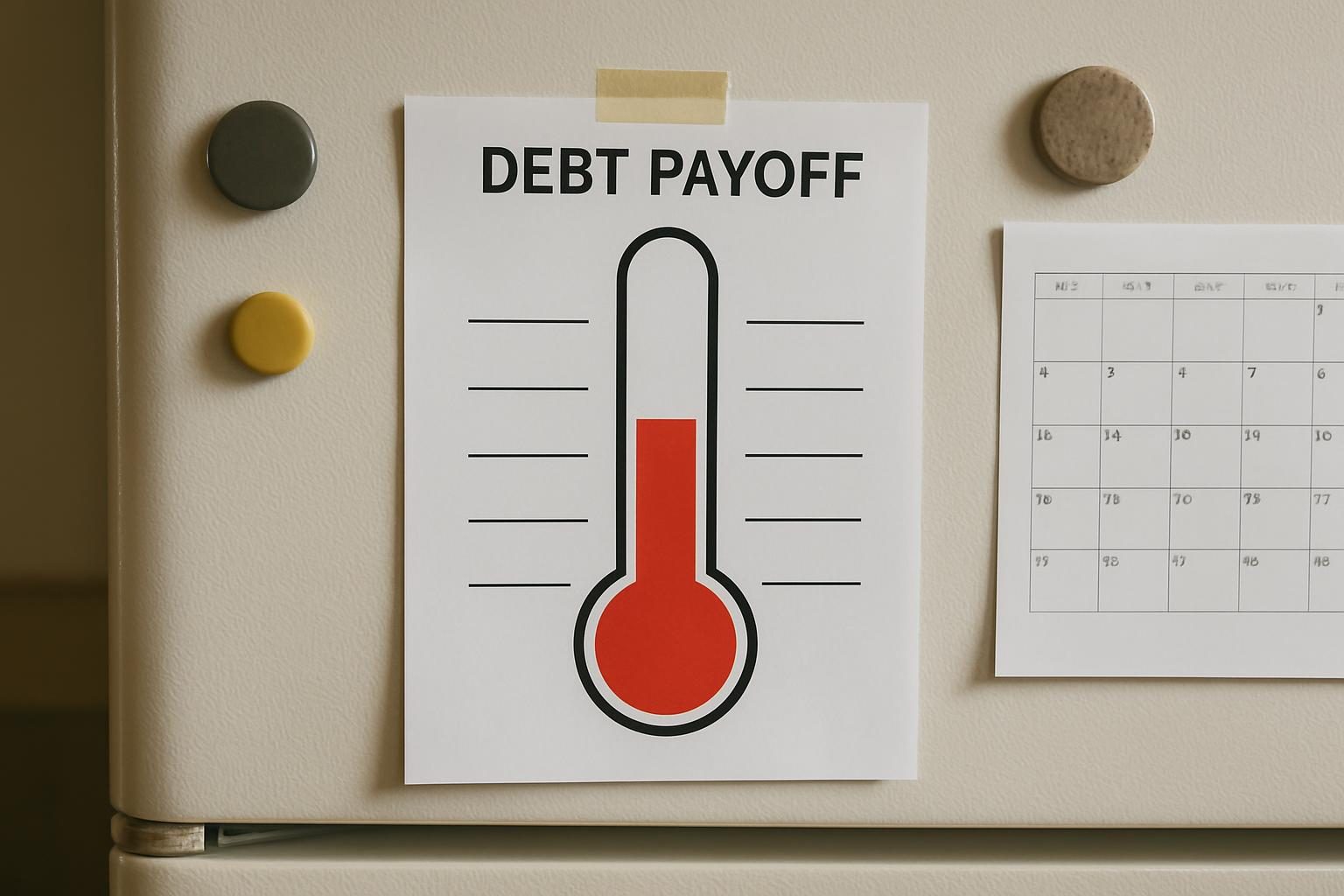
Style 1: The Thermometer Tracker
The thermometer is the classic. It works best when you have one big target, like a single credit card, a car loan, or your total debt in one number.
Sample thermometer: $10,000 goal, filled to $4,000 (40%)
Print this page, then color or mark your own fill line as you pay.
How to use it
- Write your starting total at the top (the full bar).
- Divide the bar into 10 equal sections. Each section is 10% of your starting balance.
- Every time you pay down one section’s worth, color it in.
- Add small tick marks for milestones, such as 25%, 50% and 75%.
Math example: Starting debt of $10,000 means each section is $1,000. If you pay $500 a month toward principal and interest combined, you color in a section about every two months. Interest means the real number depends on your rate, so use your statement balance, not your payment total.
Pro tip: Color based on your balance drop, not the amount you paid. A $300 payment might reduce the balance by only $220 once interest is taken out. The balance is the truth.
Color in the balance drop, not the payment amount. Interest takes its cut before progress shows.
Style 2: The Snowball List Tracker
If you have several debts, a single thermometer hides the action. A snowball list shows each debt on its own line, smallest balance first, so you can watch debts disappear one by one.
Sample snowball list (smallest to largest)
- Store card: $400 left of $400 ☐ PAID
- BNPL plan: $650 left of $650 ☐ PAID
- Credit card A: $2,800 left of $2,800 ☐ PAID
- Car loan: $9,500 left of $9,500 ☐ PAID
Cross out the old balance and write the new one each week. Check the box when a debt hits zero.
How to use it
- List every debt with its balance, rate and minimum payment.
- Order them smallest balance to largest.
- Pay minimums on everything, and throw every extra dollar at line one.
- When line one is gone, roll its full payment onto line two. That growing payment is the snowball.
Prefer to pay the highest rate first? That is the avalanche. The debt avalanche method guide shows how to reorder the same list by interest rate to save the most money. Both lists use the same layout, so the printable works for either.
Not sure you can see the finish line? Our debt snowball worksheet walks through the math line by line once it is published.

Style 3: The Coloring Grid Tracker
A coloring grid turns your goal into a grid of small squares. Each square equals a fixed dollar amount, and you color one in every time you pay that amount off. It suits people who like small, frequent wins.
Sample coloring grid: each square = $100 (20 squares = $2,000)
Six squares colored means $600 paid. Print the page and color in your own.
How to use it
- Pick a square value. Use $50 or $100 for smaller debts, $500 or $1,000 for larger ones.
- Color on payday. Each time your balance drops by one square’s worth, fill one in.
- Use two colors. One for regular payments, another for bonus money like tax refunds or side income.
- Add rewards. Pick a free treat for every 10 squares, such as a picnic or a movie night at home.
The grid pairs well with money challenges. If you want an extra push, the debt payoff challenges page has ideas that add squares faster, and the 30-day no-spend challenge includes its own tracker.
Small squares beat big goals when motivation is low. Make the next win only a few days away.
How to Print These Trackers From This Page
You do not need to download anything. Use these steps to print just the chart you want.
- Open the print dialog. Press Ctrl+P on Windows or Cmd+P on Mac.
- Choose the pages. Select the page range that contains your chosen sample so you do not print the whole article.
- Turn on background graphics. In the print settings, enable “Background graphics” so the bars and squares show.
- Set it to black and white if needed. The charts still work for pencil or crayon.
- Post it. Fridge, bathroom mirror or desk. Visible beats hidden.
If printing is clunky on your device, copy the layout onto a plain sheet of paper. A ruler, a pencil and 10 minutes are enough.
Match the Tracker to a Debt-Free Date
A chart shows how far you have come. A date shows how far you have to go. Put both on the same page.
Enter your balances, rates and monthly payment into the Debt Burn-Down Calculator to get an estimated debt-free date. Write that date at the top of your tracker. Then test small changes, such as an extra $50 a month, and see how many months you cut.
- Lower your rate: Less of each payment goes to interest, so your chart fills faster. A 0% balance transfer can pause interest on card debt for a promotional period, though fees and terms apply.
- Add income: Direct side-gig money or refunds straight to the top line.
- Cut one bill: Redirect the savings to debt right away so it does not vanish.
Need the full process from budget to payoff? The Burn-Down Plan for paying off debt fast lays it out step by step. For a longer view, a debt payoff milestones guide can help you pick checkpoints worth celebrating.
Keep Your Tracker Going
Most trackers die in week three. A few habits keep yours alive.
- Pick a fixed update day. Sunday evening works for many people.
- Use real statement balances. Log in, read the number, write it down.
- Plan for slip-ups. A missed week is data, not failure. Fill it in and move on.
- Celebrate milestones. 25%, 50% and a cleared debt each deserve a small, cheap reward.
- Keep a spare copy. Print three blank ones now so you never stall on a full sheet.
For the long haul, a how to stay motivated paying off debt guide will cover the mindset side in more depth.
Ready to speed up every chart on this page? Request free options to lower your interest rate using the form below, and see if a lower rate shortens your timeline. You can also browse the lower your rate options page for what partners may offer.
FAQ
What is the best debt payoff tracker printable for beginners?
The thermometer is the easiest to start with because it needs one number: your total debt. If you have three or more debts, switch to the snowball list so you can see each balance separately.
Should I track by balance or by payments made?
Track by balance. Interest means a $300 payment does not always cut your balance by $300. Your statement balance shows real progress.
How often should I update my tracker?
Once a week is a good rhythm for most people. Monthly works too if you only get statements monthly, but weekly check-ins keep the goal fresh.
Can a tracker help me pay off debt faster?
Indirectly. Seeing progress can keep you consistent and motivated, which helps you stick to extra payments. The speed itself comes from how much you pay and the interest rate you pay at. For questions about your specific situation, consider talking with a qualified financial professional or a nonprofit credit counselor.
See free options to lower your interest rate
A partner will review your options with you, free and with no obligation, so your payoff tracker fills up faster.
