
Quick answer: The debt avalanche method means paying the minimum on every debt, then putting every spare dollar toward the debt with the highest interest rate (APR) until it’s gone. Then you roll that payment to the next-highest rate. Mathematically, it costs the least in interest of any standard payoff plan.
Key takeaways
- Rank by APR, not balance. The highest rate gets all your extra cash.
- Minimums everywhere else. Never skip them, or late fees and credit damage cancel out your savings.
- Avalanche saves the most interest compared with the snowball, though the gap depends on how your rates and balances line up.
- The first win can take longer. Track interest saved and use small milestones to stay motivated.
If you’re juggling several balances, the debt avalanche method gives you a clear order of attack backed by simple math. You don’t need a finance degree or a special app, just a list of your debts and a monthly number you can commit to. This guide walks through the steps, a full worked example, how it compares to the snowball, and how to keep going when progress feels slow.
Want to see if a lower rate could speed things up even more? You can request free options to lower your interest rate using the form on this page.
How the Debt Avalanche Method Works
The idea is simple: interest is the enemy, so you go after the most expensive debt first. Every dollar you send to a 27% credit card saves you more than a dollar sent to a 6% loan.
- List every debt. Write down the balance, APR and minimum payment for each card, loan and balance.
- Sort from highest APR to lowest. Ignore balance size for ordering purposes.
- Pay minimums on everything. This keeps accounts current and protects your credit.
- Send all extra money to the top-rate debt. That includes tax refunds, side income and cuts from your budget.
- When it’s paid off, roll its full payment to the next debt. Your attack payment grows each time, which is where the “avalanche” name comes from.
If two debts share the same APR, pay the smaller balance first. You’ll get a faster win at no extra interest cost.
Pro tip: Check whether any rate is promotional. A card with a 0% intro APR that expires in 6 months should be treated as its post-promo rate when you plan your order.

A Worked Debt Avalanche Example
Let’s use four made-up debts and an extra $300 per month on top of minimums. These numbers are illustrative, not a forecast of your results.
- Credit Card A: $4,000 at 26% APR, $120 minimum
- Credit Card B: $2,500 at 21% APR, $75 minimum
- Auto loan: $9,000 at 8% APR, $260 minimum
- Personal loan: $3,000 at 12% APR, $110 minimum
Total minimums are $565. With the extra $300, you’re paying $865 per month toward debt.
The avalanche order
- Card A (26%) gets $420 per month ($120 minimum plus $300 extra).
- Card B (21%) comes next.
- Personal loan (12%) follows.
- Auto loan (8%) goes last.
Card A is gone in roughly 11 months. Then its $420 flows to Card B, which now gets about $495 per month and disappears a few months later. By the time you reach the personal loan and auto loan, you’re throwing close to $750 or more per month at a single balance.
You can plug in your own numbers with our free Debt Burn-Down Calculator to see your exact payoff date and total interest.
Every dollar aimed at your highest APR does more work than a dollar aimed anywhere else.
Debt Avalanche vs. Snowball: Interest Saved
The snowball method orders debts by smallest balance first, regardless of rate. In the example above, snowball would target Card B ($2,500) first, then the personal loan, then Card A, then the auto loan.
That means Card A keeps charging 26% interest for longer. Using the example numbers, that choice typically costs a few hundred dollars more in total interest over the payoff period than the avalanche. Your real gap depends on how far apart your rates are and how your balances compare.
When the gap is big, and when it’s small
- Big gap: a large balance at a very high APR, plus smaller balances at low rates.
- Small gap: debts with similar APRs, or when your highest-rate debt is also your smallest balance. In that case, both methods give nearly the same order.
Neither plan is “wrong.” The best plan is the one you’ll stick with. For a side-by-side look at all your options, see our debt payoff plans guide, or if you want a broader roadmap, read how to pay off debt fast with the burn-down plan.
Stay Motivated When the First Win Takes Longer
The avalanche’s biggest weakness is psychological. If your highest-rate debt is also a large balance, you might wait a year or more for your first payoff. Here’s how to keep momentum.
- Track interest, not just balances. Each month, note how much interest you avoided compared with minimum-only payments. It’s a real win you can see.
- Set mini-milestones. Celebrate every $500 or 10% of a balance, not only full payoffs.
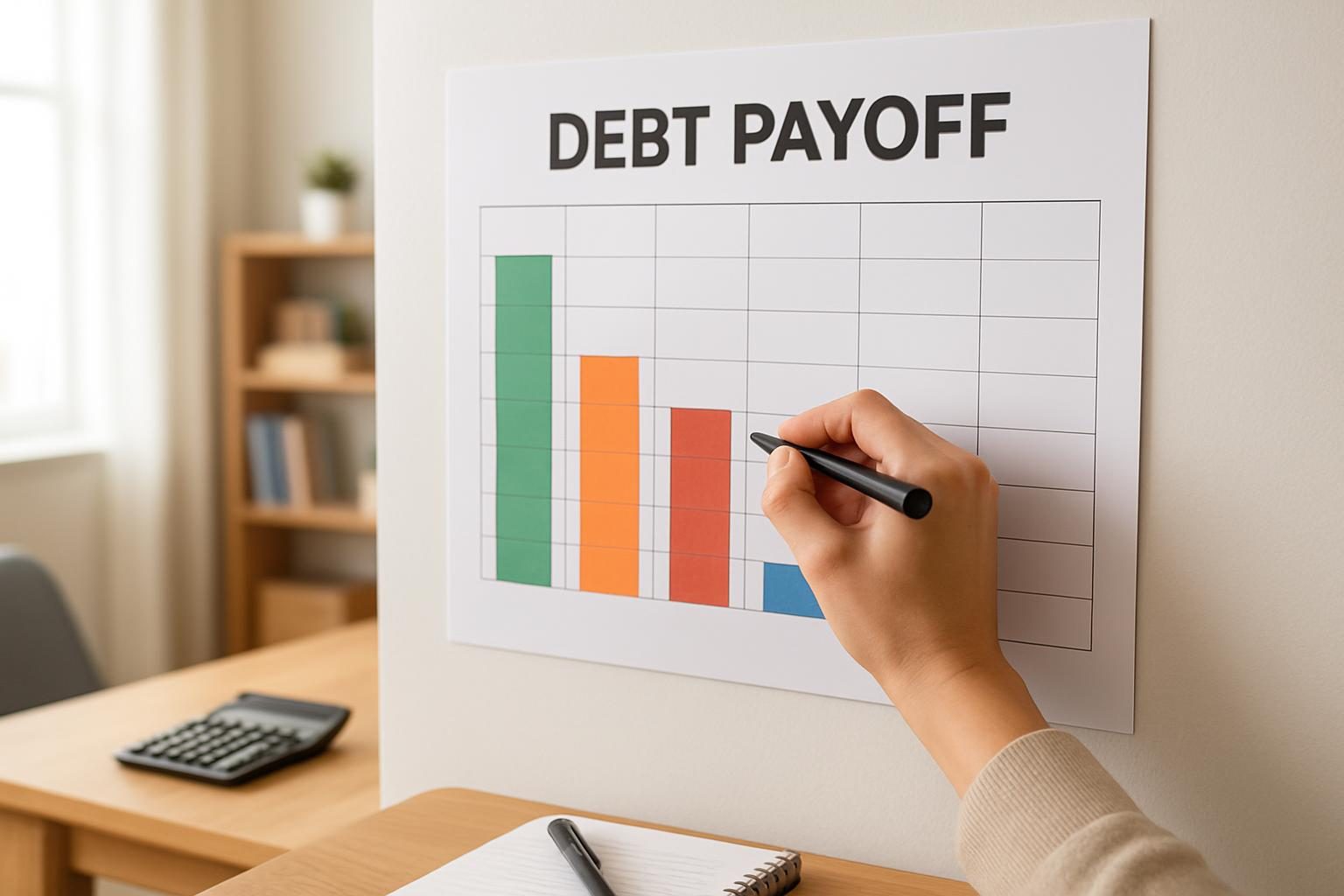
- Use a visual tracker. A paper chart or spreadsheet that fills in as balances drop makes progress tangible.
- Try a hybrid. If a tiny balance is nagging you, clear it quickly for the emotional lift, then switch back to highest-APR-first.
- Automate it. Schedule the extra payment the day your paycheck lands so it never competes with spending.
A short debt payoff challenge can also generate extra cash and a sense of momentum. Looking for more ideas? Our upcoming guide on how to stay motivated paying off debt goes deeper.
The plan that saves the most interest only works if you’re still following it in month fourteen.
Speed Up the Avalanche by Lowering Your Rates
The avalanche works on the rates you have, but you may be able to change those rates. Lower APRs mean more of each payment hits principal.
- 0% balance transfers: moving high-rate card debt to a promotional 0% card can pause interest for a set period, usually with a transfer fee (often around 3% to 5%, an estimate that varies by card). Read our balance transfer guide before you apply.
- Consolidation loans: a fixed-rate personal loan may replace several higher-rate balances with one lower payment, if you qualify.
- Refinancing: student loans, auto loans and mortgages can sometimes be refinanced at a lower rate. See our guides on paying off student loans and paying off car loans early.
Always compare fees, the new term length and whether you’d lose any borrower protections (federal student loans, for example, lose federal benefits when refinanced privately). A lower rate only helps if you keep paying aggressively and avoid running the old cards back up.
Want to see what’s available to you? Request free, no-obligation options to lower your rate with the form on this page, or browse the lower your rate page for an overview.
Common Avalanche Mistakes to Avoid
- Skipping minimums on lower-rate debts. Late fees and penalty APRs can wipe out your gains.
- Ignoring variable rates. Re-check your APRs every few months and re-sort if the order changes.
- Forgetting fees. Annual fees, transfer fees and origination fees belong in your math.
- No cushion. Keep a small starter emergency fund so one surprise bill doesn’t send you back to the cards.
- Forgetting BNPL and other balances. Include them on your list. Our BNPL and other debt guide covers how.
Not sure the avalanche is right for your situation, especially if you’re considering bigger moves like consolidation or refinancing? A nonprofit credit counselor or a qualified financial professional can review your full picture.
Ready to see which rate-lowering options might fit your debts? Request your free options using the form below.
Debt Avalanche Method FAQ
Is the debt avalanche method better than the snowball?
It’s usually cheaper in interest because it targets the most expensive debt first. The snowball can feel more motivating because small balances disappear sooner. If you’ll stick with only one, choose that one.
Do I need to pay the minimum on every debt?
Yes. Missing minimums can trigger late fees, penalty rates and credit score damage. Pay minimums on everything, then send extra money to the highest-APR debt.
How do I find my APR?
Check your monthly statement or online account. Credit card statements list the APR, and loan documents or servicer portals show the interest rate. Use the APR rather than the interest rate if both are listed.
What if my highest-rate debt is tiny or huge?
If it’s tiny, the avalanche and snowball give the same order, so you get a quick win. If it’s huge, consider a hybrid approach, or look into lowering that rate through a balance transfer or consolidation to speed things up.
Get free options to lower your interest rate
We’ll connect you with partner options to review, free and with no obligation to accept.
