
Quick answer: A debt snowball worksheet is a one-page table where you list every debt from smallest balance to largest, record the minimum payment on each, and add all your extra money to the smallest debt first. When that debt hits zero, its full payment rolls into the next one. Copy the layout below onto paper or into a spreadsheet and you can start today.
Key takeaways
- List debts by balance, smallest to largest, and ignore interest rate when ordering them.
- Pay minimums on everything, then throw every spare dollar at debt #1.
- When a debt is gone, roll its payment into the next one. That roll is the snowball.
- Spend 20 minutes once a month updating balances and adjusting your extra payment.
- Fill in the worksheet with real statement numbers, not guesses.
The snowball method works because it is simple and it produces quick wins. Paying off a small balance in a month or two gives you momentum, and momentum is what keeps most people going. The worksheet below turns that idea into numbers you can see.
Want to see if a lower rate could speed things up while you work the plan? You can request free options to lower your interest rate using the form on this page.
The Debt Snowball Worksheet Layout (Fill-In Version)
Here is the core worksheet. Copy it onto a sheet of paper, draw the grid by hand, or recreate it in a spreadsheet. Each row is one debt.
| Order | Debt name | Current balance | APR (%) | Minimum payment | Due date | Payoff target month |
|---|---|---|---|---|---|---|
| 1 | __________ | $______ | ____ | $______ | ____ | ________ |
| 2 | __________ | $______ | ____ | $______ | ____ | ________ |
| 3 | __________ | $______ | ____ | $______ | ____ | ________ |
| 4 | __________ | $______ | ____ | $______ | ____ | ________ |
| 5 | __________ | $______ | ____ | $______ | ____ | ________ |
| 6 | __________ | $______ | ____ | $______ | ____ | ________ |
| Totals | $______ | $______ | ||||
Below the main table, add this small box. It holds the numbers that drive the whole plan:
| Total monthly budget for debt | $______ |
| Minimums on all debts | $______ |
| Extra payment (budget minus minimums) | $______ |
| Snowball payment on debt #1 | $______ (its minimum plus the extra) |
Prefer a digital version with formulas built in? See our free debt snowball spreadsheet and how to set it up.
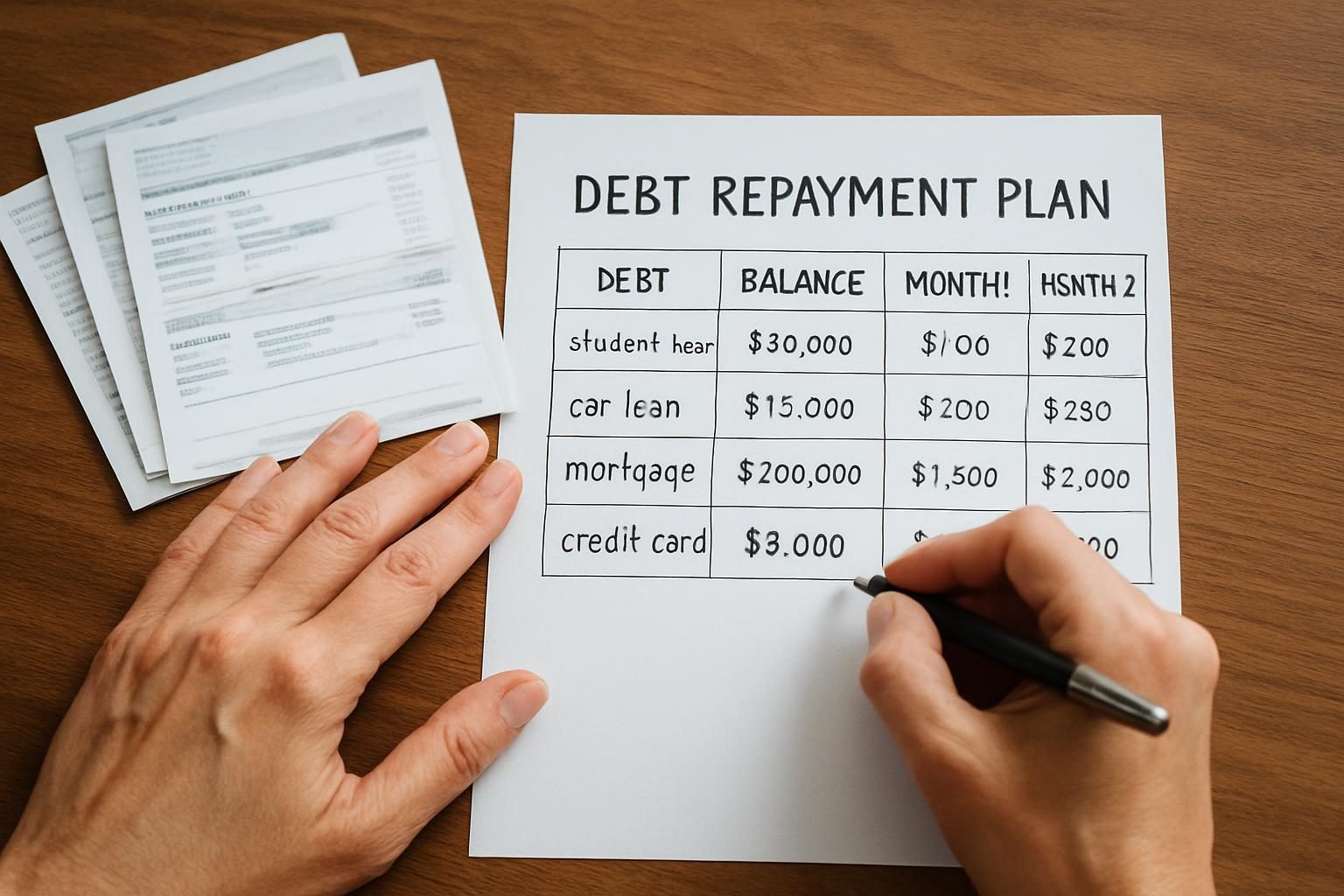
How to Fill In Your Debt Snowball Worksheet, Step by Step
Grab your most recent statements or log in to each account. Use the real numbers, even if they sting.
- List every debt. Include credit cards, personal loans, medical bills on payment plans, buy now pay later balances, car loans, and student loans. Many people leave the mortgage off the snowball and keep paying it as normal.
- Write the current balance. Use the number from your latest statement or online account, not what you remember.
- Record the APR. You are not sorting by it, but you want it visible. If a balance carries a very high rate, that is useful to know.
- Enter the minimum payment and due date. This keeps you from missing a payment while you focus on the target debt.
- Number the rows from smallest balance to largest. The smallest balance is #1. If two balances are close, put the higher-APR one first.
- Calculate your extra payment. Take your monthly debt budget, subtract all minimums, and the remainder is your snowball.
- Estimate a payoff month for debt #1. Divide its balance by its snowball payment for a rough number of months. Interest will stretch that slightly, so treat it as an estimate.
Worked example (illustrative numbers): you owe $400 on a store card, $1,800 on a credit card, and $5,200 on a personal loan. Minimums total $210 and your debt budget is $360, so your extra is $150. Debt #1 gets its minimum plus $150 each month and is gone in a few months. Then that whole payment moves to debt #2.
The snowball isn’t magic; it’s a payment that never shrinks, even as your debts do.
Where to Find Your Extra Payment
The worksheet only works if the extra number is real. Here are common places to find it:
- Trim recurring costs. Review subscriptions, insurance rates, phone plans and streaming services. Even $30 to $80 a month adds up.
- Run a short spending reset. A 30-day no-spend challenge can free up a one-time lump sum for debt #1.
- Sell unused items. Furniture, electronics and tools can become a first-month boost.
- Redirect windfalls. Tax refunds, bonuses and cash gifts can go straight to the target debt.
- Add side income. Even a few extra hours a month, sent entirely to debt, speeds things up.
Pro tip: Set up an automatic payment for each minimum, then make the extra payment to debt #1 manually or on a separate schedule. That way nothing gets missed and the snowball stays visible.
Debt Snowball vs. Avalanche: Which Order Goes on the Sheet?
The snowball sorts by balance. The avalanche sorts by interest rate, highest first, which usually costs less in total interest. The snowball often wins on motivation because you eliminate accounts sooner.
- Choose snowball if you need early wins or have several small balances.
- Choose avalanche if one or two high-APR cards dominate your interest costs. See our guide to the debt avalanche method.
- Not sure? Walk through the options in our debt payoff plans guide, then pick the one you will actually stick with.
You can also compare plans side by side with the Debt Burn-Down Calculator before committing to a sort order.

The Payment Log: Track Every Month
The first worksheet is your plan. This second one is your scoreboard. Add one row per debt per month, or one block per month, whichever fits your page.
| Month | Debt # | Starting balance | Payment made | Ending balance | Notes |
|---|---|---|---|---|---|
| ________ | __ | $______ | $______ | $______ | ________ |
| ________ | __ | $______ | $______ | $______ | ________ |
| ________ | __ | $______ | $______ | $______ | ________ |
| ________ | __ | $______ | $______ | $______ | ________ |
Seeing the ending balance drop each month is the point. For something more visual, try our free debt payoff tracker printables, including thermometer and coloring charts.
Your 20-Minute Monthly Review Routine
A plan only works if you check it. Pick the same day each month, such as the day after payday, and run this routine.
- Update balances. Pull current numbers from each account and write them in.
- Confirm payments posted. Check that every minimum and your extra payment cleared.
- Look for new charges. New credit card spending works against the plan. Pause card use on the debts you are paying down if you can.
- Recalculate the extra amount. Did your income or expenses change? Adjust the snowball up or down.
- Cross off finished debts. When a debt hits zero, move its full payment (minimum plus extra) to the next row.
- Update your payoff month. Recheck the estimate for the current target debt.
- Celebrate something small. A free treat is fine. Progress deserves a mark.
Twenty minutes a month with your real balances beats hours of worrying about them.
Ways to Speed Up the Worksheet
Once the basic plan runs, look for ways to shrink the timeline:
- Lower your interest rates. A 0% promotional balance transfer can stop interest on card debt while you pay it down. Read our balance transfer guide and the step-by-step on how to do a balance transfer, and watch for transfer fees, which are commonly a few percent of the amount moved.
- Consolidate wisely. A consolidation loan can simplify payments, but only helps if the rate is lower and you stop adding new balances.
- Tackle other balances. Buy now pay later plans and store financing belong on the sheet too. See our BNPL and other debt guide.
- Pick a challenge. Browse our debt payoff challenges for structured ways to find extra cash.
Not sure where to start? Our step-by-step guide on how to pay off debt fast walks through the full burn-down plan. And if you want to see how long your payoff will take, a guide to estimating your payoff timeline is coming soon.
Curious whether a lower rate, balance transfer or refinance could trim months off your plan? You can request free, no-obligation rate options using the form on this page.
FAQ
What should I include in a debt snowball worksheet?
At minimum: each debt’s name, current balance, APR, minimum payment and due date, plus your total monthly debt budget and extra payment. A monthly payment log is a useful second page.
Should my mortgage go on the snowball?
Most people leave the mortgage out and keep making regular payments, since it is usually the largest, lowest-rate debt. If you want to pay it off early later, see our mortgage payoff guide.
What if I can’t afford more than the minimums?
Start by finding even a small extra amount, such as $20 to $50. If that is not possible yet, focus on trimming expenses or increasing income, and keep making every minimum on time. A nonprofit credit counselor can also review your budget; you can find reputable options through the Consumer Financial Protection Bureau.
How often should I update my worksheet?
Once a month works for most people. Update balances after each statement closes, and adjust the plan any time your income or expenses change.
See free options to lower your interest rate
Partners will share free, no-obligation options like 0% balance transfers or consolidation loans so you can compare them against your payoff plan.
