
Quick answer: Couples paying off debt together succeed when they agree on three things: the full list of what’s owed, how much money goes to debt each month, and who does what. Start with a calm, scheduled money talk, build a simple yours/mine/ours budget, and track progress on one shared sheet you both can see.
Key takeaways
- Put every debt, from both of you, on one list before you debate strategy.
- Hold a short, scheduled money talk with an agenda instead of ambushing each other mid-argument.
- A yours/mine/ours system protects autonomy while still funding the payoff plan.
- One shared tracker beats two private ones: progress is motivating when you both see it.
- Pick a method (snowball or avalanche) together; the best plan is the one you’ll both stick to.
Debt is rarely just a math problem when two people share a life. It’s tangled up with habits, fears, family history and fairness. The math is the easy part, so we’ll start there, then deal with the human part.
Want to see if a lower rate could shorten your timeline before you sit down together? You can request free options to lower your interest rate using the form on this page.
Why Couples Paying Off Debt Together Often Stall
Most couples don’t fail because of bad math. They stall because each person is working from a different, unspoken picture.
- Different information: One partner knows every balance; the other has a vague sense it’s “a lot.”
- Different pain tolerance: One wants to live lean and finish in two years; the other wants a slower pace with room to breathe.
- Different stories about money: Growing up with scarcity, windfalls or financial secrecy shapes how each of you reacts to a budget.
- Blame: “Your student loans” versus “my credit cards” turns a shared goal into a scoreboard.
The fix is to turn debt from his and hers into ours to solve. That doesn’t mean everything is legally shared. It means the plan is.
Note that legal responsibility varies. In most states, debt you took on before marriage generally stays yours, while rules for debt taken on during marriage differ by state, especially in community property states. If this matters for your situation, ask a qualified professional.
The Money Talk Agenda: 5 Steps for a Calm First Conversation
Don’t start this conversation at 10 p.m. after a stressful day or while a bill is open on the table. Schedule it like an appointment and keep the first one to about 60 to 90 minutes.
- Set the tone (5 minutes). Agree on ground rules: no interrupting, no “you always,” and a break is allowed if things get heated. State the shared goal in one sentence, such as “We want to be debt-free by [year] without wrecking our relationship.”
- Lay everything on the table (20 minutes). Each person lists every debt: lender, balance, interest rate, minimum payment and due date. Include credit cards, student loans, car loans, medical bills, buy now, pay later balances and money owed to family. No hiding, no editorializing.
- Total it up (5 minutes). Add the balances and the minimum payments. Seeing one number is often a relief compared with the fog of not knowing.
- Find your monthly payoff number (20 minutes). Combine take-home pay, subtract essentials, and decide how much can go to debt above minimums. Be honest, not heroic.
- Choose next steps and a date (10 minutes). Decide who will build the tracker, who will call lenders about rates, and when you’ll check in again.
Pro tip: End every money talk with one thing each of you appreciated about the other’s effort. It sounds small, but it keeps the conversation from feeling like an audit.
Yours, Mine and Ours: A Budget That Protects Both of You
Total transparency does not have to mean total control. Many couples do best with a three-bucket system that funds the plan and still leaves each person some freedom.
How the three buckets work
- Ours: Joint account for rent or mortgage, utilities, groceries, insurance, minimum debt payments and the extra debt payoff amount. Both incomes feed this account.
- Yours: Personal spending money for one partner, no questions asked.
- Mine: Personal spending money for the other partner, same rules.
Splitting contributions fairly
Two common approaches:
- 50/50: Simple, but it can feel unfair when incomes differ a lot.
- Proportional to income: If one of you earns 60% of the household income, that person funds 60% of the joint account. Many couples find this feels more equitable.
Here’s a quick estimate. Say one partner takes home $3,600 a month and the other $2,400, for $6,000 total. Shared costs and debt payments total $4,800. Proportionally, they’d contribute $2,880 and $1,920. The remaining $1,200 is split into personal spending, however you choose.
Keep personal money small but real. An allowance of even $75 to $150 each per month (an estimate, adjust to your budget) can prevent the resentment that makes strict budgets collapse. If income is tight, our guide to paying off debt on a tight income shows how to build a realistic plan with less room to spare.
A budget one partner secretly resents is a budget that won’t survive the first stressful month.
Choose a Payoff Method You’ll Both Actually Follow
Once you know the numbers, pick a strategy together. The two classics are:
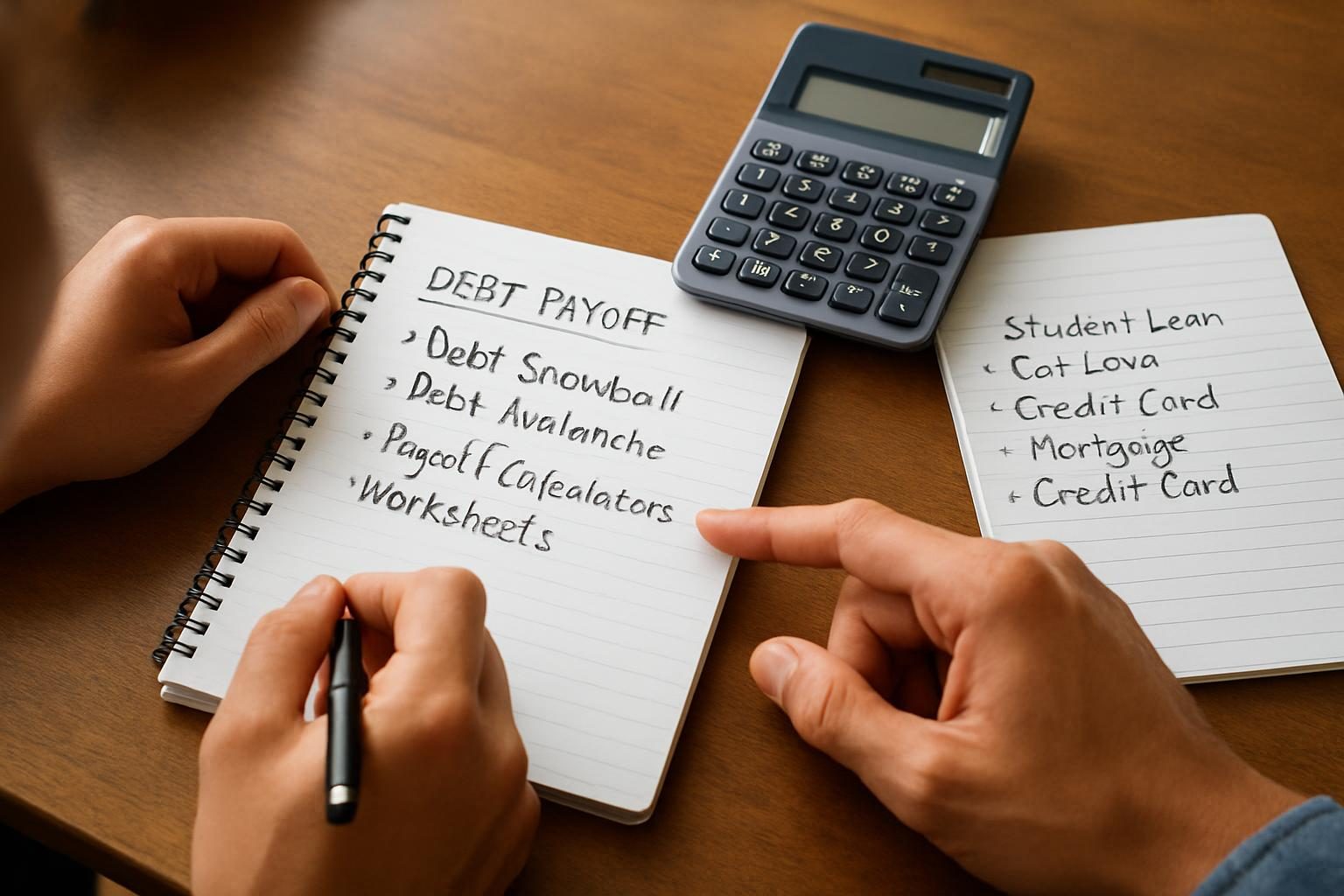
- Debt snowball: Pay minimums on everything, throw extra money at the smallest balance first, then roll that payment into the next. It delivers quick wins.
- Debt avalanche: Target the highest interest rate first. It usually costs less in total interest.
If one of you is motivated by momentum and the other by math, that’s a real conversation, not a flaw. Our breakdown of debt snowball versus avalanche walks through both so you can compare them on your own numbers. Some couples compromise: knock out one or two tiny balances for early wins, then switch to avalanche order.
For the full range of options, see our debt payoff plans guide. And to see what your combined numbers actually produce, plug them into the Debt Burn-Down Calculator together. Seeing a real debt-free date on the screen makes the plan feel concrete.

Build One Shared Debt Tracker
A tracker works best when both people can see it and both people care about it. Keep it simple enough that nobody dreads updating it.
What to include
- Every debt with balance, rate, minimum payment and due date
- The payoff order and the monthly extra amount
- A column for each month’s ending balance
- The target debt-free date, updated as you progress
Where to keep it
A shared spreadsheet is plenty. If you want a printable version, try the debt snowball worksheet, or set up a free debt snowball spreadsheet that updates itself. Not sure whether to use an app? Apps versus a simple spreadsheet covers what you actually need.
Make progress visible
Post a debt-free chart on the fridge or save it as a shared phone wallpaper. Color in a square each time a milestone hits. It’s a small ritual, and it gives you something to celebrate together.
Progress you can both see is progress you’ll both protect.
Keep the Momentum Going Month After Month
The first month is exciting. Month seven is where couples drift. Build in structure so enthusiasm isn’t doing all the work.
- Monthly 20-minute check-in: Update the tracker, review spending, and adjust if something changed. Keep it short and predictable.
- A “surprise” rule: Agree in advance that any unplanned expense over a set amount, say $100, gets a quick conversation first. That’s an estimate; pick a number that fits your budget.
- Planned fun: Budget for dates and small treats. Strict plans without any joy tend to break.
- Short bursts: Try a pantry challenge or one of these money saving challenges as a team project to free up extra cash.
When motivation dips, which it will, our piece on staying motivated while paying off debt has practical ideas. And if a windfall lands in your lap, decide ahead of time how you’ll split it between debt and fun. A rule like 70% to debt and 30% to enjoy keeps both of you invested. For more on that, watch for our upcoming guide on using a windfall to pay off debt.
Lower the cost of the debt itself
Part of getting aligned is shrinking the mountain. A lower interest rate means more of every payment hits principal. Options to look at include a 0% intro APR card (see our balance transfer guide), a consolidation loan, or refinancing student or auto loans. Check the fees, the promotional period length and the rate after it ends before committing. If you’d like to see what’s available for your situation, request free options to lower your rate with the form on this page. It’s free and carries no obligation.
When One Partner Is Behind or Resistant
Sometimes one person is fully committed and the other is anxious, defensive or checked out. A few things help:
- Lead with the shared goal, not the past. “I want us to feel free” lands better than “you spent too much.”
- Start small. Agree on one change for 30 days. Our first 30 days guide is a good template.
- Bring in a neutral party if needed. A nonprofit credit counselor or a financial therapist can help when talks keep stalling. Our comparison of where to get help paying off debt lays out the options.
If finances are tied to bigger relationship concerns, such as hidden accounts or financial control, a qualified counselor is a better first stop than a spreadsheet.
Ready to see what a lower rate could do for your shared timeline? Request your free rate options with the form on this page.
FAQ: Couples Paying Off Debt Together
Should we combine all our finances to pay off debt?
Not necessarily. Many couples keep some separate accounts and use a joint account for shared bills and debt payments. What matters is transparency about balances and agreement on the plan, not whether every dollar sits in one account.
Am I responsible for my spouse’s debt?
It depends on whose name is on the debt, when it was taken on and where you live. Generally, premarital debt stays with the person who borrowed it, but state rules differ, especially in community property states. Check with a qualified professional for your situation.
Who should we pay off first, my debts or theirs?
Treat it as one combined list and order it by your chosen method, snowball or avalanche. Ranking by balance or rate, rather than by whose name is on it, removes the blame and keeps the focus on the math.
How much should we keep in savings while paying off debt?
Many couples build a small starter emergency fund first so a surprise bill doesn’t land on a credit card. The right amount depends on your income stability and expenses. Our guide on whether to pay off debt or invest can help you think through the tradeoffs, and an upcoming article will cover emergency fund versus credit card payoff in depth.
See free options to lower your couple’s debt interest rate
Share a few details and we’ll connect you with free, no-obligation options from partners to help cut your interest costs.

