
Quick answer: To refinance a car loan, get your payoff amount and your car’s value, check your credit, compare offers from several lenders, then submit the paperwork for the one with the lowest total cost. It makes the most sense when you can get a meaningfully lower APR, you owe less than the car is worth, and your current loan has no prepayment penalty.
Key takeaways
- Refinancing only wins if the new loan costs less in total, not just per month.
- Negative equity (owing more than the car is worth) is the biggest roadblock to approval.
- Shop rates within a short window so multiple credit pulls count as one inquiry in most scoring models.
- Keep paying your old loan until the new lender confirms payoff.
A car loan is one of the easier debts to shrink with a smarter rate. A lower APR means more of every payment hits principal, which is exactly what a payoff plan wants. Here is the full checklist, in order, with the math behind each step.
Want to see which lenders might beat your current rate? You can request free refinance options using the form on this page.
Step 1: Get Your Loan Payoff Amount and Terms
Before you shop anything, know exactly what you are replacing. Log in to your lender’s portal or call the number on your statement and ask for a 10-day payoff quote. This figure is usually a bit higher than your statement balance because it includes interest accrued through the payoff date.
Write down these numbers:
- Payoff amount: what a new lender must pay to close your loan.
- Current APR: the rate you are trying to beat.
- Remaining months: so you can compare apples to apples.
- Monthly payment: your baseline.
- Prepayment penalty: ask directly whether one applies (more on this below).
If you are not sure how to read your contract, our guide on how to check your car loan for prepayment penalties walks through it.
Step 2: Check Your Equity (Car Value vs. Payoff)
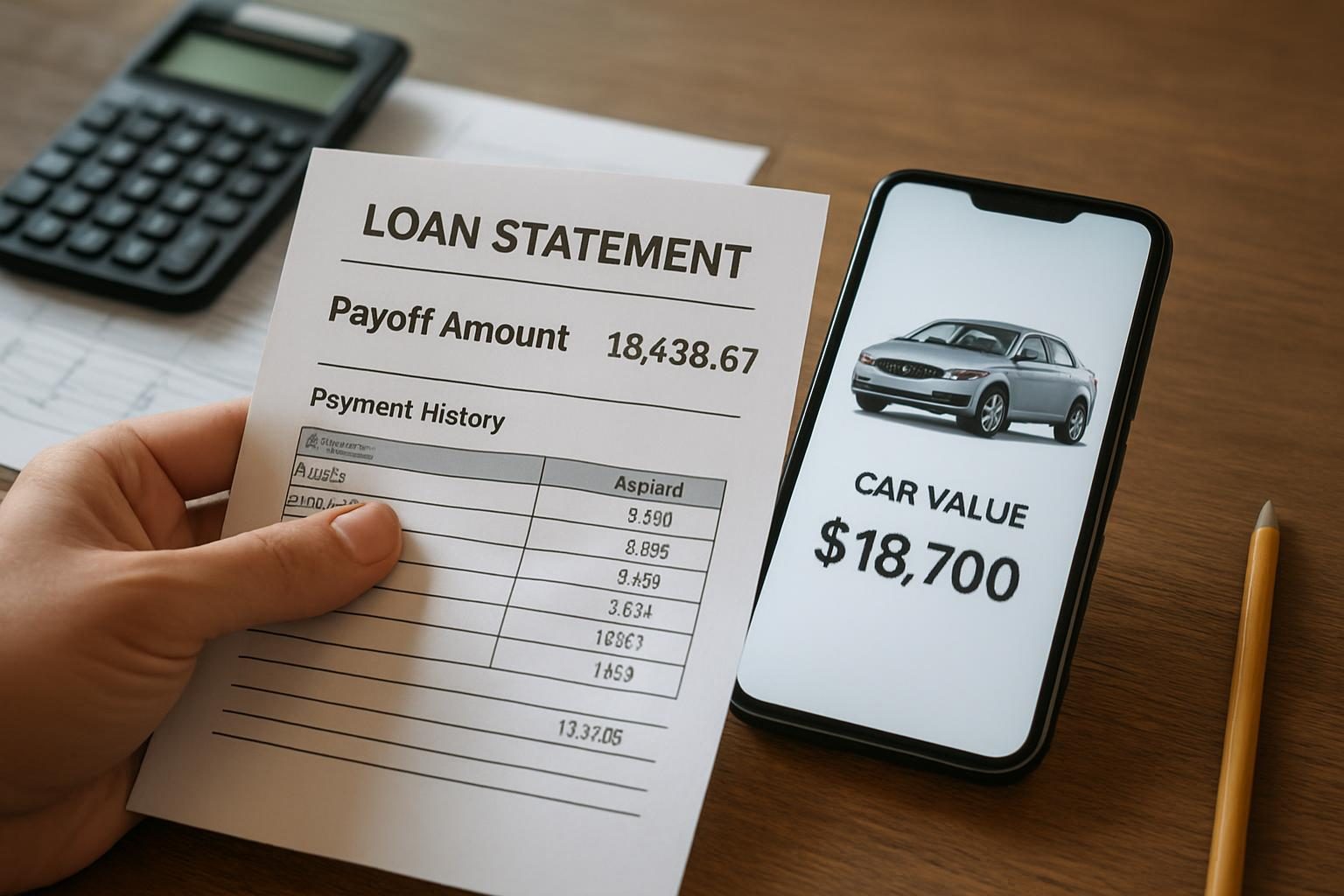
Lenders want the car to be worth at least what you owe. Look up your vehicle’s estimated value using a free valuation tool such as Kelley Blue Book or Edmunds, and be honest about mileage and condition. Then compare it to your payoff amount.
- Positive equity: car value is higher than payoff. You are a strong candidate.
- Break-even: value roughly equals payoff. Approval is possible but terms may be tighter.
- Negative equity: you owe more than the car is worth. Many lenders will decline or require cash to cover the gap.
Lenders also tend to set limits on vehicle age and mileage. As a rough estimate, many cap eligibility somewhere around 10 years old or 100,000-150,000 miles, but this varies by lender, so check each one.
Pro tip: If you are underwater, ask your current lender what it would cost to pay the gap down first. Even a few hundred dollars toward principal can move you from “declined” to “approved.” See our breakdown of options when you owe more than the car is worth.
A lower payment feels like a win, but only a lower total cost is a real one.
Step 3: Check Your Credit Before You Apply
Your credit score is the biggest driver of the rate you will be offered. Pull your free reports at AnnualCreditReport.com, the official site authorized by federal law, and look for errors you can dispute before lenders see them.
Then compare where you stand today to where you were when you bought the car. If your score has climbed since then, or your original loan came from a dealer markup, you may have real room to save.
- Score improved by 40+ points: strong refinance candidate.
- Score about the same: still worth checking if market rates have dropped or your dealer rate was high.
- Score dropped: refinancing may not beat what you have. Focus on rebuilding first.
Not sure what rate your score should earn? Our guide to average auto loan APR by credit score gives you a benchmark.

Step 4: Compare Car Loan Refinance Offers
Now shop. Check offers from credit unions, banks and online lenders. Credit unions often have competitive auto rates, so include at least one.
Most scoring models treat multiple auto-loan inquiries made within a short window (commonly 14 to 45 days, depending on the model) as a single inquiry. Keep your shopping tight and you limit the credit impact. Many lenders also offer prequalification with a soft pull, which does not affect your score.
For each offer, compare these line items side by side:
- APR (not just the advertised rate).
- Loan term in months.
- Monthly payment.
- Fees: origination, application, title transfer.
- Total cost = monthly payment x months + upfront fees.
Run the break-even math
Here is a simple example (illustrative numbers only). Say you owe $18,000 at 9.5% APR with 48 months left, a payment of about $452. Refinancing to 6.5% over the same 48 months drops the payment to roughly $427 and saves around $1,200 in interest. If fees total $100, you are still well ahead.
Now the trap: stretch that same loan to 60 months at 6.5% and the payment falls further, but you pay interest for an extra year. Always compare total cost over the same timeframe. Our break-even math for refinancing shows how to check this in minutes, and the Debt Burn-Down Calculator lets you plug in your own numbers.
Stretching a loan to shrink the payment can cost you more interest than the lower rate saves.
Step 5: Watch for Prepayment Penalties and Fees
Two cost traps can quietly erase your savings.
- Prepayment penalty on the old loan: some contracts charge a fee for paying the loan off early. They are less common on auto loans than they once were, and some states restrict them, but check your contract rather than assuming.
- Fees on the new loan: origination fees, title and registration charges and lien filing fees. Many refinance lenders charge little or nothing, but a few add up to a couple hundred dollars (estimate).
- Precomputed interest: rare, but some older or subprime loans front-load interest, which reduces what you save by refinancing mid-loan.
Add every fee to the total cost comparison. If a fee eats most of your projected savings, skip the refinance and consider simply paying extra toward principal instead.
Step 6: Gather Paperwork and Apply
Once you pick the winner, submit a full application. Have these documents ready:
- Driver’s license and proof of address
- Proof of income (recent pay stubs or tax returns if self-employed)
- Vehicle registration, VIN and current odometer reading
- Proof of insurance
- Your current lender’s name, account number and payoff quote
The new lender will review your file, then send final loan documents to sign. Read the final APR, term and fee disclosure carefully before you sign, and confirm they match the offer.
Step 7: Close the Old Loan and Confirm Everything
After signing, the new lender typically pays off your old loan directly and takes over the lien on your title. This can take a couple of weeks.
- Keep paying your old loan until you see a zero balance, so you never miss a payment.
- Confirm payoff with the old lender in writing.
- Set up autopay on the new loan and note the first due date.
- Refund check: if your old payoff came in lower than expected, you may receive a small refund of overpaid interest.
When Refinancing Is Not the Right Move
Skip it, or wait, if any of these apply:
- You are underwater and cannot cover the gap.
- Only a few months remain on the loan, so there is little interest left to save.
- The best offer saves less than the fees cost.
- You would extend the term so far that the total interest goes up.
For a deeper look at the cases where it pays off, read refinancing a car loan to pay it off faster and our full explainer on how auto loan refinancing works and what it costs. Our car loan payoff guide covers the bigger picture. If you are weighing timing, the upcoming guide on when to refinance a car loan will help.
Ready to see what rate you could qualify for? Request free car loan refinance options with the form on this page, no obligation.
FAQ: Refinancing a Car Loan
How soon can I refinance a car loan?
Many lenders want a few months of on-time payments first, and some require the original loan to be at least 3 to 6 months old (this varies). There is generally no legal waiting period, but your title and registration need to be in place.
Will refinancing hurt my credit score?
You may see a small, temporary dip from the hard inquiry and the new account. Shopping within a short window limits the inquiry impact, and on-time payments on the new loan help your score over time.
Can I refinance with bad credit?
Sometimes, but rates will be higher and savings smaller. It works best if your score has improved since you bought the car. A co-signer can also help. We plan to cover this in a dedicated guide to refinancing a car loan with bad credit.
How much does it cost to refinance a car loan?
Many lenders charge no application fee, but some add origination, title or lien fees that can total roughly $0 to $300 (estimate). Always add fees into your total-cost comparison before you commit.
This article is educational and not financial advice. Rates, fees and eligibility vary by lender and state. Consider speaking with a qualified financial professional about your situation.
Get free car loan refinance options
A partner lender will review your details and share free, no-obligation options to lower your rate.

