Quick answer: You can refinance a car loan to pay it off faster if the new loan has a meaningfully lower rate, a shorter term, or both, and the fees don’t eat the savings. The best move is usually to keep your old monthly payment on the new loan, so the lower rate turns into extra principal instead of a smaller bill.
Key takeaways
- A lower rate only helps you pay off faster if you keep paying the same amount (or more) each month.
- Run the break-even math: total fees divided by monthly interest savings.
- Loan-to-value (LTV) limits can block a refinance if you owe more than the car is worth.
- Stretching the term to cut your payment usually costs more interest overall, not less.
- Check for prepayment penalties on the old loan before you apply.
Refinancing is one of the few debt moves where one decision can shave months off your payoff date and hundreds or thousands off your interest. It can also quietly backfire. This guide walks through the math so you can tell which one you’re looking at.
Ready to see what’s available? You can request free rate options using the form on this page and compare them against the numbers below.
How refinancing a car loan to pay it off faster actually works
When you refinance, a new lender pays off your current auto loan and you start fresh with new terms. Three levers decide whether that speeds up your payoff:
- Rate (APR): A lower APR means more of each payment hits principal.
- Term: A shorter term forces a faster payoff, but raises the required payment.
- Fees: Title transfer, lien and application fees add to your cost and can cancel out small rate drops.
The key insight is that refinancing doesn’t pay off your loan faster by itself. Your payment behavior afterward does. A lower rate gives you room to attack principal harder, but only if you choose to.
For a deeper look at the lower-payment side of the coin, see our breakdown of when refinancing lowers your payment and when it does not.
Rate, term and fees: the three numbers to compare
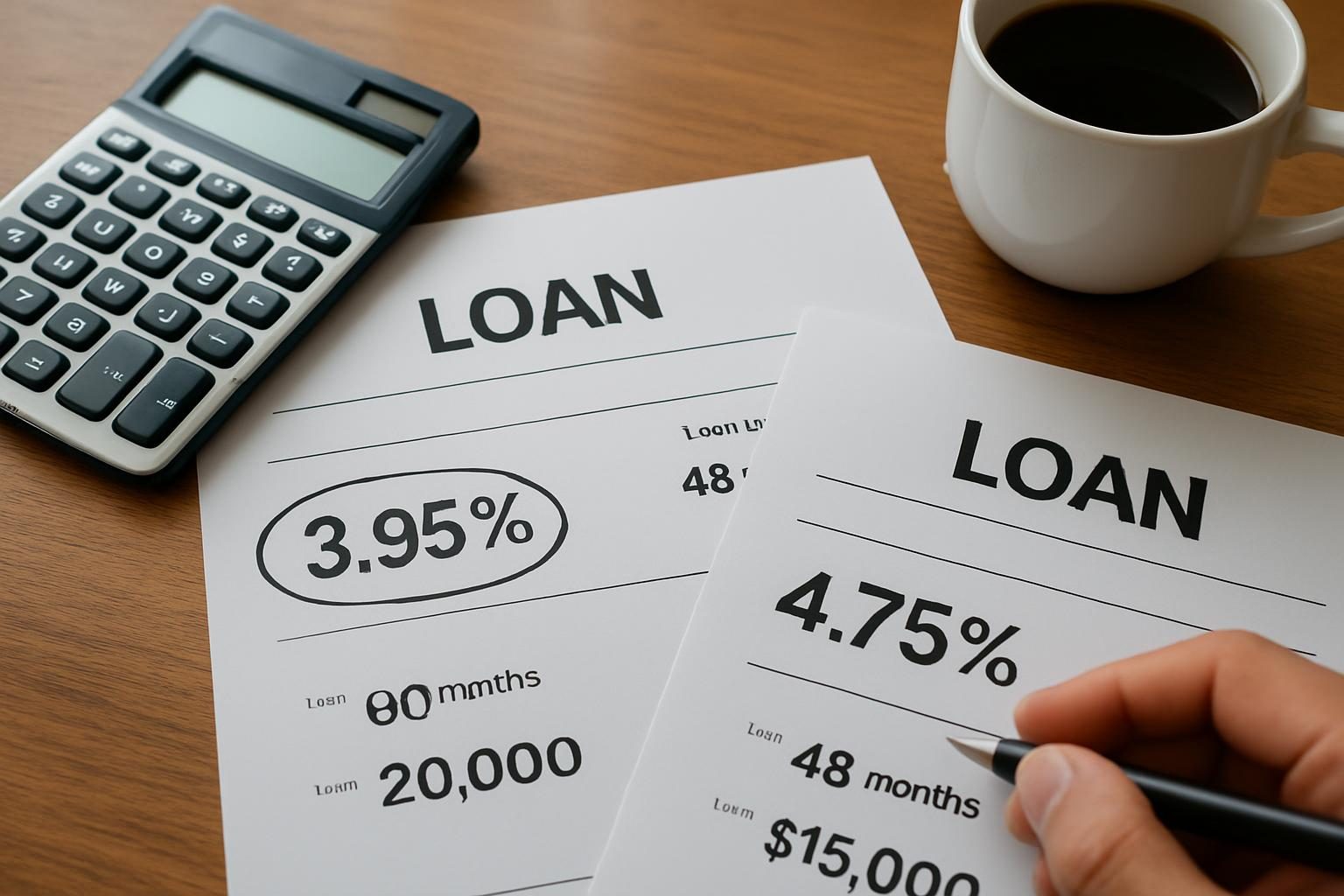
Put your current loan and any offer side by side. You need five figures for each: remaining balance, APR, months left, monthly payment and upfront fees.
Rate
As a rough rule of thumb, a rate drop of about 1 to 2 percentage points on a balance of several thousand dollars with a few years left is often where refinancing starts to feel worthwhile. Smaller drops can still work on large balances with long remaining terms. Rates vary widely by credit score, vehicle age and lender, so treat any range you see as an estimate and check current auto loan rates before you shop.
Term
Term is where most people accidentally lose. Compare these two example scenarios on a $15,000 balance (illustrative numbers only):
- Scenario A: 36 months left at 9% APR. Payment is about $477. Total interest is roughly $2,170.
- Scenario B: Refinance to 60 months at 6% APR. Payment drops to about $290, but total interest is roughly $2,400.
Scenario B has the lower rate and the lower payment, yet it costs more overall and keeps you in debt two years longer. A lower rate on a longer term can be a trap.
Fees
Many auto refinances have low or no application fees, but you may still pay a title and registration transfer fee that varies by state, often in the range of tens of dollars up to roughly $100 or more, and some lenders charge origination fees. Always ask for the total upfront cost in writing.
A lower rate on a longer term can cost you more than the loan you started with.
Break-even math before you apply
Break-even tells you how many months it takes for interest savings to cover your fees. The formula is simple:
- Add up all refinance fees (title transfer, origination, any other charges).
- Estimate your monthly interest savings. Multiply your balance by the old APR and by the new APR, divide each by 12, and subtract.
- Divide total fees by monthly savings. That’s your break-even in months.
Example (estimate): On a $15,000 balance, going from 9% to 6% cuts first-month interest from about $112 to about $75, so you save roughly $37 in month one. With $100 in fees, you break even in about three months. If you plan to keep the car and the loan for years, that’s an easy win.
Interest savings shrink as the balance falls, so use this as a first-pass check. For a fuller walkthrough, our guide on auto loan refinance break-even math shows how to run it before you apply.
Pro tip: Shopping rates usually triggers credit inquiries. Auto loan inquiries made within a short window are generally treated as one for scoring purposes, so do your comparison shopping in a tight stretch of days rather than spread over weeks.

Keep the same payment on a shorter term
This is the strategy that makes refinancing a true payoff tool. Instead of letting the new lower rate shrink your payment, you keep paying what you paid before.
How to do it:
- Note your current monthly payment.
- Ask the lender for a new term that lands close to that same payment at the lower rate.
- If the required payment comes out lower, set up autopay for the old amount anyway and confirm extra funds go to principal.
Using the earlier $15,000 example: at 6% over 36 months the payment is about $456. If you were paying $477, you’re not squeezed at all, and you shave interest while keeping the 36-month finish line, or even cut a month or two by paying the old amount.
Before you commit, check whether the new loan charges prepayment penalties. Most auto loans don’t, but it’s worth confirming, and our guide to checking for car loan prepayment penalties explains how.
Want to see how extra payments change your finish date? Plug your numbers into the pay off car loan early calculator.
Refinancing lowers your rate; keeping your payment is what actually lowers your payoff date.
Loan-to-value limits and when refinancing won’t work
Lenders compare what you owe to what the car is worth. That ratio is your loan-to-value, or LTV. A common illustration: owing $18,000 on a car worth $15,000 is a 120% LTV.
Many lenders cap LTV somewhere around 100% to 125%, though limits differ by lender. Refinancing is harder in these situations:
- You owe more than the car is worth: You may be declined or offered a worse rate. Paying down principal first can help close the gap.
- The car is old or high-mileage: Many lenders set maximum vehicle age and mileage limits.
- Your balance is small: Some lenders have minimum loan amounts.
- Your loan is nearly paid off: There’s little interest left to save, so fees can outweigh the benefit.
- Your credit hasn’t improved: If your score is the same or lower than when you bought, a better rate is unlikely.
If negative equity is your issue, our upcoming guide to negative equity car loans will cover options in detail. And if the payment itself is the problem, see how to get out of a car loan you cannot afford.
A simple decision checklist
Refinancing probably makes sense if most of these are true:
- Your credit has improved or market rates have dropped since you bought.
- The new APR is at least about 1 percentage point lower.
- You have more than a year or two of payments left.
- Break-even happens within a few months.
- You’ll keep paying your old amount, or choose a shorter term.
- Your LTV is comfortably within lender limits.
If you’re juggling several debts, a car loan refinance is one piece of a bigger plan. Our debt payoff plans guide shows how to order your debts, and the car loan payoff guide covers every other way to finish a loan early. When you’re ready to compare offers, our lower your rate page is the place to start.
Curious what you could qualify for? Request free rate options with the form on this page and compare them with your break-even math. This article is educational, not financial advice, so consider talking with a qualified professional about your situation.
FAQ
Does refinancing a car loan hurt my credit?
It can cause a small, temporary dip from the hard inquiry and the new account, and the average age of your accounts may shift. For most borrowers who make on-time payments afterward, the effect fades over time.
How soon can I refinance after buying a car?
Policies vary by lender. Some want several months of payment history and a title in your name first. If your rate was high because of a low score at purchase, waiting until your credit improves can get you a better offer.
Is it better to refinance or just make extra payments?
If the new rate is only slightly lower, extra payments on your current loan may beat refinancing because there are no fees. If you can drop the rate by a point or more, doing both is the strongest combination.
Can I refinance if I owe more than the car is worth?
Sometimes, but it’s harder. Many lenders cap LTV, so you may need to pay down the balance, add a down payment or wait until the gap closes before you qualify.
Compare free car loan refinance rate options
A partner will share free, no-obligation options so you can compare rates and terms before you decide.


