
Quick answer: A debt payoff planner works best when you assign every bill and extra payment to a specific paycheck instead of treating the month as one lump sum. List your paydays, list your due dates, cover minimums from the paycheck that lands before each date, then aim all leftover cash at one target debt.
Key takeaways
- Plan by paycheck, not by month: each pay date gets its own list of bills and extra payments.
- Minimums go first, matched to the paycheck that arrives before the due date.
- Extra money goes to one target debt, chosen by snowball (smallest balance) or avalanche (highest rate).
- A planner is a monthly map; it differs from a printable tracker or a one-evening plan.
- Review it for 10 minutes each payday and it stays accurate.
Most people build a debt budget around a monthly total, then wonder why the account runs dry on the 20th. The fix is simple: match each obligation to the paycheck that funds it. If you want to build the planner while you read, request a free look at lower-rate options using the form on this page to shrink the interest you’re planning around.
What a Debt Payoff Planner Actually Is
A debt payoff planner is a one-month calendar of money moves. It shows when each paycheck arrives, which bills it covers, and where your extra payment goes. Think of it as the “when” layer on top of your “what to pay” strategy.
It also has a different job than other tools on this site:
- The one-evening plan: sets your strategy and order once. See how to make a debt payoff plan in one evening.
- Printable trackers: show your progress over months. Browse the free debt payoff tracker printables.
- The planner: runs your cash flow inside a single month, paycheck by paycheck.
If you haven’t picked a strategy yet, start with the debt payoff plans guide, then come back here to put it on a calendar.
Gather Your Numbers First
Before you draw anything, collect five facts. Pull them from your statements and your pay stubs, not from memory.
- Paydays: the exact dates and take-home amount of each paycheck this month.
- Due dates: every debt payment, plus rent or mortgage, utilities, insurance and subscriptions.
- Minimums: the required payment on each debt.
- Balances and rates: so you can choose a target debt.
- Your extra amount: what’s left after essentials and minimums.
Irregular income? Use your lowest recent paycheck as the baseline and treat anything above it as a bonus for the target debt. If you’re unsure of balances and rates, the Debt Burn-Down Calculator can help you see how much extra changes your payoff date.
The Simple Planner Layout
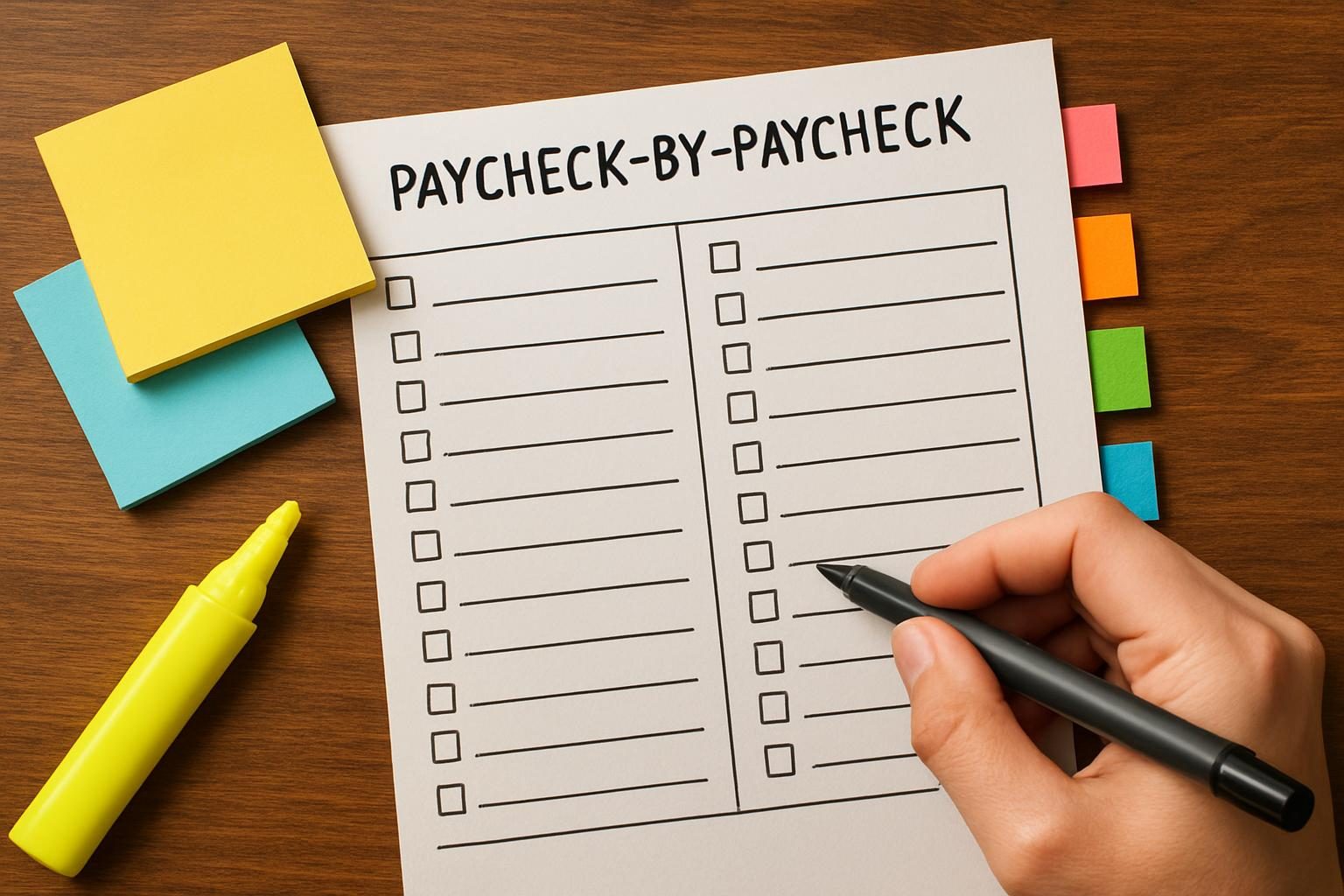
You only need a sheet of paper or a spreadsheet with one block per paycheck. Each block has the same five lines.
Pro tip: Put the due date next to every bill. The goal is to see at a glance which paycheck must cover which date.
Layout for each paycheck block:
- Pay date and amount: for example, “Fri the 5th: $1,450.”
- Fixed bills due before the next payday: rent, utilities, insurance, phone.
- Debt minimums due before the next payday: each with its due date.
- Living money: groceries, gas and spending for this pay period.
- Extra to target debt: whatever remains.
Add a small “leftover” line at the bottom of each block. If it’s negative, you’ve found a cash crunch before it hit your checking account.
A month is too big a container for a budget; a paycheck is the right size.
Map Due Dates to the Right Paycheck
The core rule is this: a bill belongs to the paycheck that arrives on or before its due date and is closest to it. A bill due on the 3rd is funded by the paycheck from the 1st or earlier, not the one on the 15th.
Here’s a worked example for someone paid on the 1st and 15th, with $1,500 take-home each time. These figures are illustrative.
Paycheck 1 (the 1st): $1,500
- Rent due the 1st: $900
- Car insurance due the 5th: $110
- Credit card A minimum due the 8th: $45
- Student loan due the 10th: $120
- Living money for the 1st to 14th: $250
- Leftover to target debt: $75
Paycheck 2 (the 15th): $1,500
- Utilities due the 18th: $150
- Phone due the 20th: $60
- Credit card B minimum due the 22nd: $35
- Car loan due the 25th: $310
- Living money for the 15th to 30th: $300
- Leftover to target debt: $645
Notice the lopsided result. The first paycheck carries rent, so it has less extra. That’s normal, and seeing it prevents you from promising $360 to a debt on the 1st when the money isn’t there.
Decide Where the Extra Payment Goes
Every dollar of leftover cash goes to one target debt while the rest stay on minimums. Which target you pick depends on your method:
- Snowball: smallest balance first, for quick wins. Use the debt snowball calculator to order your debts.
- Avalanche: highest interest rate first, which usually costs the least in interest. A planned guide on the avalanche method for credit card debt will go deeper.
You can send extra in two ways. Either pay the target card once per paycheck, or split it: a small payment early in the cycle and the rest later. Paying sooner can trim interest slightly because daily-balance cards charge interest on the balance as it stands each day.
Keep the minimums on autopay and make the extra payment manually. That way a rough week can reduce your extra without causing a late fee.
Handle Tricky Due Dates
Real life rarely lines up neatly. Use these fixes when it doesn’t.
- Due date falls just before payday: ask your lender or card issuer to move the due date. Many will let you pick a date that follows your paycheck.
- Three-paycheck months: if you’re paid every two weeks, two months a year have three paychecks. Plan the third one entirely as extra for your target debt.
- Weekly or irregular pay: group several deposits into a “pay period” block that ends before the next big bill cluster.
- Annual or quarterly bills: divide them by the number of paychecks and set that amount aside each time.
Moving one due date can fix a cash crunch that no budget trick will.
A 10-Minute Weekly Planner Routine
The planner only helps if it stays current. Build a short habit around payday.
- Check the deposit: confirm the paycheck matches what you planned.
- Pay what’s due: send the minimums and bills listed for that block.
- Send the extra: make the target-debt payment right away so it doesn’t get spent.
- Update balances: note the new balance and recalculate your payoff date.
- Look ahead: scan the next block for surprises.
When you want a motivation boost, borrow ideas from debt payoff challenges or debt payoff milestones worth celebrating. Short spending freezes can feed extra into the planner; a planned article on no-spend challenge ideas will cover options.
Lower the Interest You’re Planning Around
A planner moves your payments around. It doesn’t change what they cost. If your cards charge high rates, a lower rate means more of each payment attacks principal.
Two common options to explore:
- 0% balance transfer: moves card debt to a promotional rate, usually with a transfer fee. Read the balance transfer guide to check the math.
- Consolidation loan: replaces several payments with one fixed payment, which simplifies your planner. Compare it in debt consolidation loan vs. 0% balance transfer.
Either option only works if you stop adding new card balances while you pay down the old ones. If you’d like to see what rates you might qualify for, request free options to lower your interest rate through the form on this page. It’s no obligation, and you can compare before deciding. For personal decisions involving large balances, consider talking with a qualified financial professional or a nonprofit credit counselor.
Frequently Asked Questions
How is a debt payoff planner different from a debt tracker?
A planner decides what you’ll pay and when within one month. A tracker records progress over time, such as balances falling month to month. Use both: the planner drives action and the tracker keeps you motivated.
What if my income changes month to month?
Plan with your lowest expected paycheck, cover essentials and minimums first, and treat anything extra as a bonus for your target debt. Rebuild the planner each month using actual pay dates and amounts.
Should I pay extra every paycheck or once a month?
Paying every paycheck is usually easier because the money is in hand and not yet spent. It can also cut interest slightly on cards that calculate interest daily, though the difference is typically small compared with the amount you pay.
Can I use a spreadsheet instead of paper?
Yes. A simple spreadsheet with one block per paycheck works well. See debt payoff apps vs. a simple spreadsheet to decide what fits you.
See free options to lower your interest rate
A partner will review your options with you, free and with no obligation.