Quick answer: At 22% APR, $10,000 in credit card debt takes about 52 months to clear at $300 a month, about 26 months at $500 and about 15 months at $800. Total interest runs roughly $5,600, $2,570 and $1,460 in those cases. Cutting your rate with a 0% balance transfer or a lower-rate loan can shave that interest by thousands.
Key takeaways
- At 22% APR, the first month’s interest on $10,000 is about $183, so a $300 payment barely dents the balance.
- Going from $300 to $500 a month cuts about two years off the timeline and saves roughly $3,000 in interest.
- A 0% transfer or lower-rate loan can make every dollar you pay go to principal. Check fees first.
- All figures here are estimates that assume a fixed APR, no new charges and on-time payments.
The good news is that $10,000 is a very beatable number once you see the math. Below are the timelines, a payment-by-payment snapshot and the ways to lower your rate. Request your free options to lower your interest rate using the form on this page.
How to Pay Off $10,000 in Credit Card Debt: The Short Math
Card interest is charged on your balance, which is why a high rate hurts so much. At 22% APR, your monthly rate is about 1.83% (22% divided by 12). On $10,000 that is roughly $183 of interest in month one. For a deeper look at the mechanics, see how credit card interest is calculated from APR to daily charge.
That is why the payment size matters so much:
- Pay only about $283: a typical 1%-plus-interest minimum on this balance barely moves the principal. Our credit card minimum payment calculator shows what minimums really cost.
- Pay $300: only about $117 of your first payment reduces the balance.
- Pay $800: about $617 of your first payment reduces the balance.
The rest of this guide assumes a 22% fixed APR. Your card may be higher or lower, and many cards have variable rates. Check your statement for the real number.
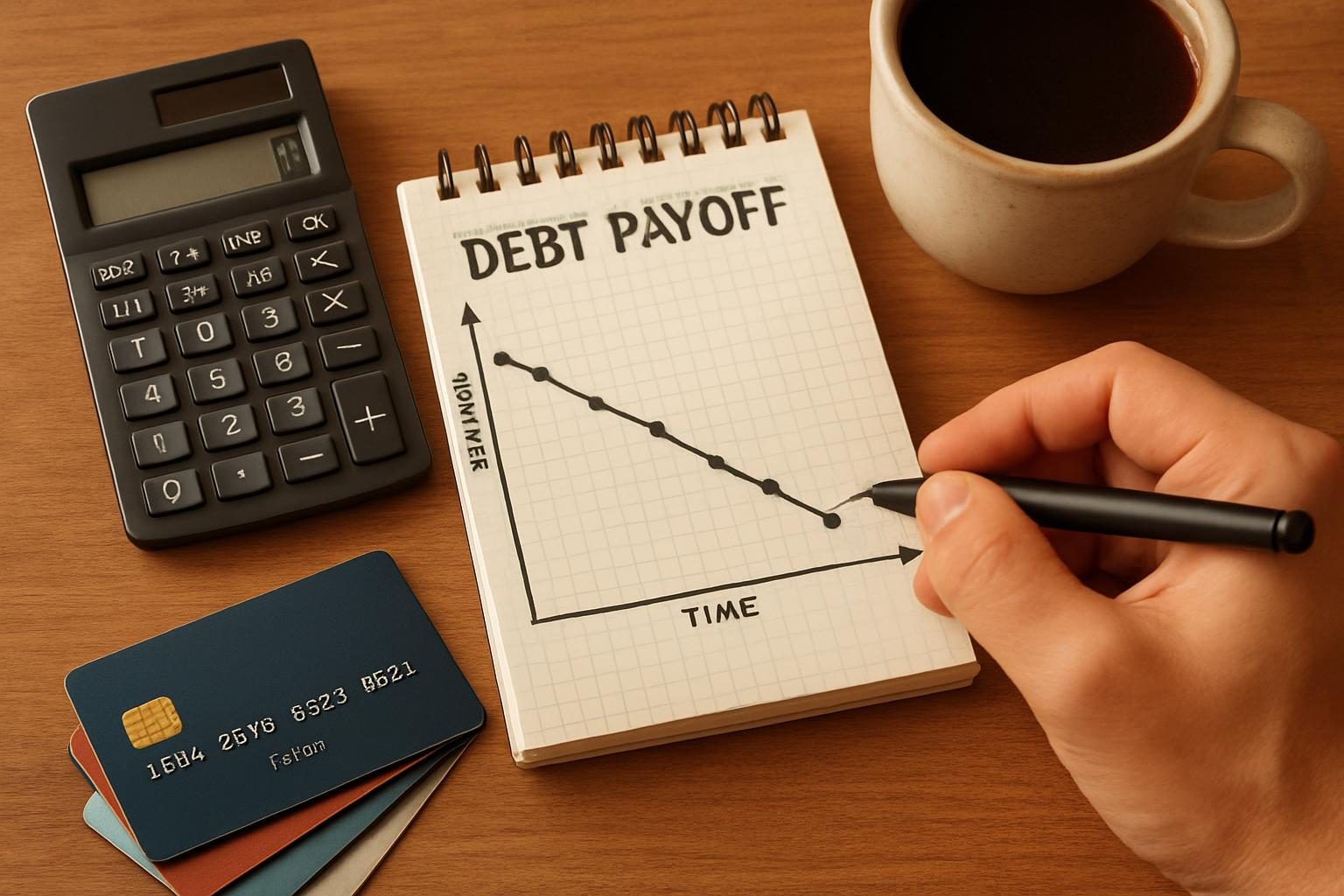
Three Payoff Timelines at 22% APR
Here is how long $10,000 lasts at three fixed payments, with no new purchases:
- $300 a month: about 52 months (4 years, 4 months). Total paid is roughly $15,600, so interest is about $5,600.
- $500 a month: about 26 months (2 years, 2 months). Total paid is roughly $12,570, so interest is about $2,570.
- $800 a month: about 15 months. Total paid is roughly $11,460, so interest is about $1,460.
The last payment in each plan is smaller than the rest. Figures are rounded and will shift a few dollars depending on how your issuer calculates daily interest.
Pro tip: Pushing from $300 to $500 saves about 26 months and roughly $3,000. Pushing from $500 to $800 saves 11 more months and about $1,100. Bigger payments have the biggest payoff early on.
An extra $200 a month on a 22% card can erase more than two years of payments.
Amortization Snapshot: Where Each Payment Goes
Early payments are mostly interest. Here is the first-month split and the remaining balance at key points:
$300 a month
- Month 1: $183 interest, $117 principal
- Month 12: balance about $8,450
- Month 24: balance about $6,520
- Month 36: balance about $4,120
- Month 48: balance about $1,140; paid off in month 52
$500 a month
- Month 1: $183 interest, $317 principal
- Month 12: balance about $5,790
- Month 24: balance about $560; paid off in month 26
$800 a month
- Month 1: $183 interest, $617 principal
- Month 6: balance about $6,130
- Month 12: balance about $1,810; paid off in month 15
Want your own numbers? Plug your balance and rate into our credit card payoff calculator or the Debt Burn-Down Calculator to see your debt-free date.

Option 1: Use a 0% Balance Transfer to Stop the Interest
A 0% intro APR balance transfer card moves your balance to a card that charges no interest for a promo period, often 12 to 21 months (estimate; offers vary). Most charge a transfer fee, commonly around 3% to 5%.
Here is the math on $10,000 with a 3% fee:
- Starting balance: $10,300 ($10,000 plus a $300 fee)
- Payment to clear it in 18 months: about $572 a month
- At $500 a month: about $1,300 would remain after 18 months, costing roughly $45 more in interest at 22% before it is gone. Total cost is about $345, versus about $2,570 on the original card.
Watch for these catches:
- Approval and limits: you may not get a limit large enough for the full $10,000. See what to do if your debt is bigger than the transfer limit.
- Promo expiry: any leftover balance reverts to the card’s regular APR.
- Mistakes: a late payment can end the promo rate. Review the 7 balance transfer mistakes that wipe out your savings.
Our balance transfer guide walks through the full process.
Option 2: A Lower-Rate Personal Loan
If you cannot qualify for a transfer card, or you want a fixed end date, a personal loan can replace card debt with a fixed payment. Rates depend on your credit and income, and the examples below are illustrations, not quotes.
- 12% APR, 36 months: about $332 a month and about $1,960 in interest.
- 12% APR, 24 months: about $471 a month and about $1,300 in interest.
- Fees: some lenders charge an origination fee (often in the range of 1% to 8%), which is taken out of your loan proceeds.
Compare that to the same $300 payment on a 22% card, which would cost around $5,600 in interest. For a head-to-head comparison, read balance transfer vs. personal loan and the math on using a personal loan to pay off credit cards.
A loan only helps if you stop running up the cards. Otherwise you can end up with both balances.
A Step-by-Step Plan to Burn the $10,000
- Confirm your numbers. Write down the balance, APR and minimum payment for each card.
- Pick a payment you can sustain. Look at your budget and choose a number near $500 if you can. Our guide to debt payoff plans covers how to build one.
- Cut the rate. Call your issuer to ask for a lower APR (how to negotiate a lower credit card interest rate), or compare transfer and loan offers in our lower-your-rate options form.
- Automate it. Set up an automatic payment above the minimum so it happens before you can spend the money.
- Feed it extra cash. Send tax refunds, bonuses and side income straight to the balance. See how to use a windfall to pay off debt and the best order for tax refund payoff.
- Track progress. Update your balance monthly. Seeing it drop keeps you going.
If your $10,000 is spread across several cards, compare debt snowball vs. avalanche to choose which card gets the extra dollars first. If cash is tight, try a debt payoff challenge to free up money.
Every point of APR you cut is money that stays in your pocket instead of your lender’s.
Ready to see which rate-lowering option fits your credit and balance? Request your free, no-obligation options with the form on this page. This is educational information, not financial advice, so consider talking with a qualified professional about your situation.
FAQ
How long does it take to pay off $10,000 in credit card debt?
At 22% APR, about 52 months at $300 a month, 26 months at $500 and 15 months at $800. A lower rate or a larger payment shortens the timeline.
How much interest will I pay on $10,000 of credit card debt?
Roughly $5,600 at $300 a month, $2,570 at $500 and $1,460 at $800, assuming 22% APR and no new charges. Your actual cost depends on your APR and how your issuer calculates interest.
Is a balance transfer worth it for $10,000?
Often yes, if you can pay off most of the balance within the 0% promo period. Subtract the transfer fee (commonly around 3% to 5%, or $300 to $500 here) from your interest savings to see the net gain.
Should I use a personal loan or a balance transfer card?
A transfer card usually costs less if you can clear the balance during the promo. A personal loan makes more sense if you need a longer, fixed payoff schedule. Both depend on your credit, so compare real offers before choosing.
See free options to lower your card interest rate
A partner will review your options for a 0% transfer, consolidation loan or refinancing with you, free and with no obligation.