
Quick answer: A HELOC payoff calculator works in two phases: during the draw period you usually owe interest only (so the balance doesn’t shrink), then in the repayment period the balance amortizes over a fixed number of years. To get an honest payoff date, enter your current balance, today’s variable rate, and the exact draw and repayment lengths, then test extra principal payments on top.
Key takeaways
- Interest-only payments during the draw period don’t reduce principal, so the clock only starts shrinking your balance in repayment.
- Your payment can jump sharply when repayment begins, often by 50% or more, so model it before it happens.
- A HELOC rate is usually variable, so run at least three rate scenarios, not one.
- Extra payments during the draw period are the single biggest lever for shortening your timeline.
- Always check your own HELOC agreement; terms vary by lender.
A home equity line of credit looks simple on the statement but behaves differently from a credit card or a standard loan. The calculator you use needs to match that structure, or the payoff date it shows will be wrong. Below is the math, how to feed a variable rate into any tool, and how extra payments change the picture.
Want help lowering the rate on what you owe? You can request free options to lower your interest rate using the form on this page.
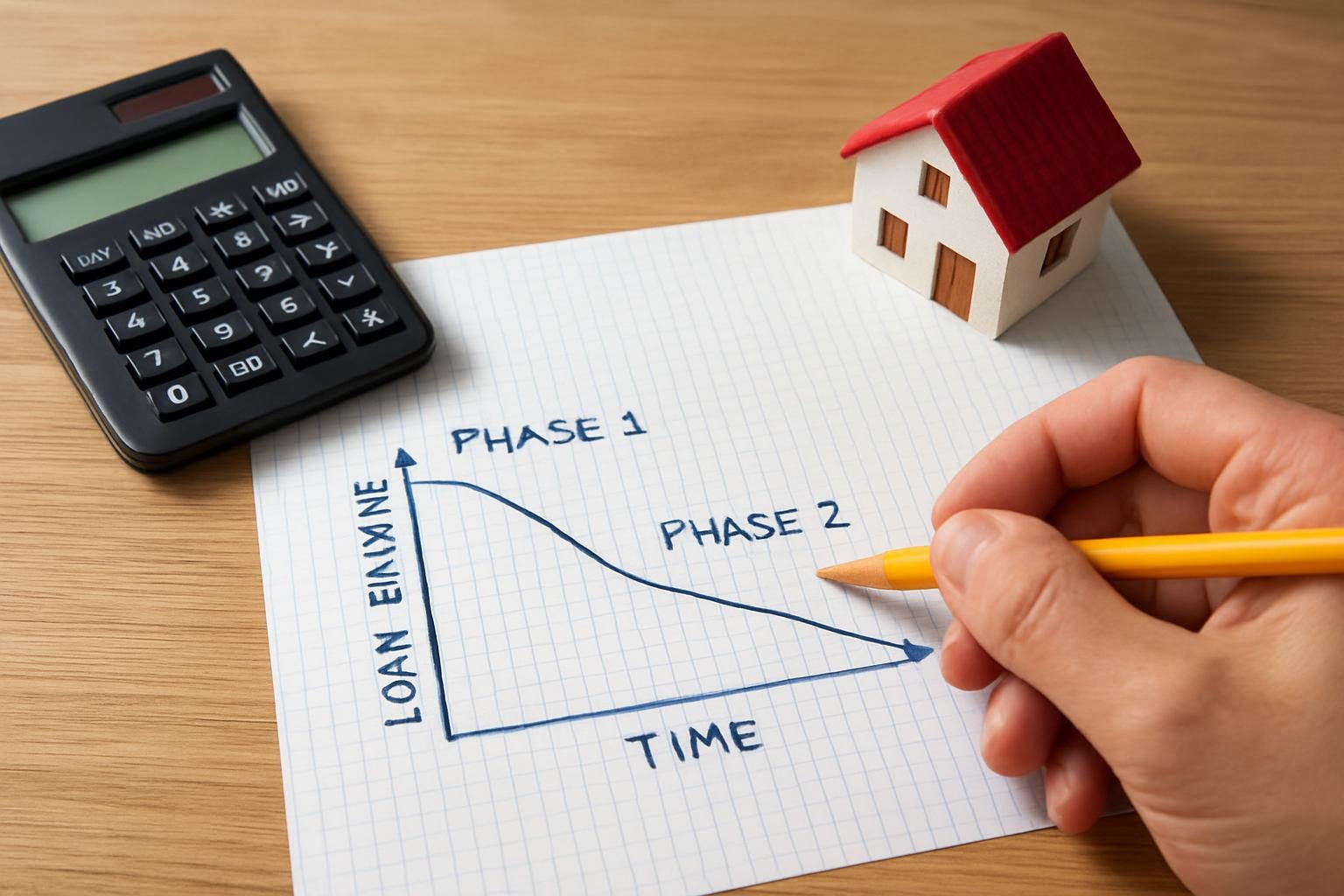
How a HELOC Is Structured: Draw Period vs. Repayment Period
Most HELOCs have two stages. The exact lengths are set by your lender, but a 10-year draw followed by a 10- to 20-year repayment is a common pattern (an estimate, not a rule).
- Draw period: You can borrow against the line as needed. Required payments are often interest only, though some lenders require a small principal portion.
- Repayment period: You can no longer borrow. The balance, plus interest, is paid off in equal-ish installments until it reaches zero.
- Balloon variants: A few HELOCs require the full balance at the end of the draw period. If yours does, treat the draw end date as your hard deadline.
The key point for any HELOC payoff calculator: the calculator must know which phase you are in and how many months remain in each.
The Interest-Only Math During the Draw Period
Interest-only payments are easy to compute and easy to underestimate. The formula is:
Monthly interest payment = balance × (annual rate ÷ 12)
Here is an illustrative example, with made-up round numbers for teaching:
- Balance: $40,000
- Rate: 9% variable
- Interest-only payment: $40,000 × 0.0075 = $300 per month
After 5 years of paying only that $300, you would have paid $18,000 and still owe the full $40,000. That is the trap: the payment feels affordable, but the debt hasn’t moved.
An interest-only payment keeps the lights on, but it never lowers the balance by a single dollar.
What Happens When Repayment Begins
When the draw period ends, the same balance is amortized over the repayment term. Using the same example at 9% over a 15-year repayment:
- Standard amortization payment on $40,000 at 9% for 180 months: roughly $406 per month
- That is about $106 more than the old interest-only payment.
- Shorten the repayment to 10 years and it rises to roughly $507 per month.
The jump is larger the longer you stayed interest only and the shorter the repayment window. If your draw period is ending within a few years, plug the numbers in now so the new payment doesn’t surprise your budget.
Pro tip: Set a calendar reminder 12 months before your draw period ends. That’s your window to refinance, pay down principal or adjust your budget on your own terms.
How to Enter a Variable Rate in a HELOC Payoff Calculator
Most HELOC rates are an index (often the prime rate) plus a margin, so they move over time. Few free calculators model rate changes month by month, so use scenarios instead.
- Find your current rate on your latest statement (index plus margin).
- Run a base case with today’s rate held constant.
- Run a stress case with the rate 2 percentage points higher.
- Run a relief case with the rate 1 point lower.
- Compare payoff dates and total interest across all three.
- Check your rate cap in your agreement; it limits how high the stress case can realistically go.
If your calculator allows only one rate, run it again each time your rate resets, using your current balance as the new starting point. That keeps the projection honest.

Inputs to Gather Before You Calculate
Pull these from your most recent statement or loan agreement:
- Current balance: what you owe today, not your credit limit.
- Current APR: the variable rate as of this billing cycle.
- Months left in the draw period: and whether payments are interest only.
- Repayment term: in months, as stated in your agreement.
- Planned extra payment: a monthly amount and any one-time lump sums.
If you have several balances to organize, the Debt Burn-Down Calculator lets you see them together, and the Early Payoff Calculator shows interest saved on a single loan.
The calculator is only as honest as the numbers you feed it, so start with your real statement.
How Extra Payments Shorten the Timeline
Extra payments are powerful on a HELOC because interest is calculated on a daily or monthly balance. Every dollar of principal you remove stops accruing interest immediately.
Using the same $40,000 at 9% example, here is the rough effect of paying extra during a 15-year repayment (estimates for illustration):
- Minimum only (about $406/month): paid off in 15 years, with roughly $33,000 in total interest.
- Add $100/month: payoff in roughly 10.5 years, saving well over $10,000 in interest.
- Add $250/month: payoff in roughly 7 years, with interest cut by more than half.
The biggest win is paying principal during the draw period. Even paying $200 extra each month on that interest-only line cuts the balance before repayment starts, which lowers your future payment shock and total interest.
Ways to Find the Extra Money
- Redirect a raise, bonus or tax refund as a lump sum.
- Run a short debt payoff challenge and send the savings to principal.
- Use a paycheck-by-paycheck approach like the debt payoff planner.
Always confirm with your lender that extra payments are applied to principal and that there is no prepayment penalty or early closure fee. Some HELOCs charge one if you close the line within the first few years.
Using a HELOC Strategically (and Safely)
A HELOC is secured by your home, so unpaid balances put the house at risk. That makes the payoff plan more important than with unsecured debt.
- If you borrowed to pay off higher-rate cards, the HELOC velocity banking breakdown explains the math and the risks of cycling a line against a mortgage.
- If rate swings worry you, compare a fixed-rate option such as a personal loan or a refinance.
- Want a quicker route to a lower rate? Explore ways to lower your rate.
- Looking ahead, our upcoming guide on how to pay off a HELOC early will go deeper on tactics.
This article is educational, not financial advice. For large decisions involving your home, talk with a qualified financial professional or HUD-approved housing counselor. The Consumer Financial Protection Bureau also publishes a plain-language guide to HELOCs at consumerfinance.gov.
Ready to see what lower-rate options might exist for your balance? Use the form on this page to request free, no-obligation rate options.
HELOC Payoff Calculator FAQ
Does a HELOC payoff calculator work with a variable rate?
Most calculators assume one fixed rate, so run several scenarios (today’s rate, plus 2 points, minus 1 point) and recalculate whenever your rate resets. This gives you a realistic range for your payoff date.
Should I pay extra during the draw period?
Usually yes, if your budget allows. Extra principal during an interest-only phase reduces the balance that gets amortized later, lowering both total interest and the payment you face when repayment begins.
Why did my HELOC payment jump?
The draw period likely ended. Your payment switched from interest only to principal plus interest over a fixed term, so the same balance now has to be paid down on a schedule.
Is there a penalty for paying off a HELOC early?
Some lenders charge an early closure or prepayment fee if you close the line within a set number of years. Check your agreement or ask your lender before making a large payoff.
See free options to lower your HELOC or loan rate
A partner will review your options with you, free and with no obligation.


