Quick answer: A car loan payoff calculator shows how extra principal payments shorten your loan and cut interest. On a $30,000 loan at 7% over 60 months, adding $50 a month saves roughly $530 in interest and about 5 months. Adding $100 a month saves roughly $970 and about 10 months.
Key takeaways
- Extra money only helps if the lender applies it to principal, not to next month’s payment.
- Small extras add up: $50 to $100 a month can cut several months to over a year off a car loan.
- The higher your APR, the more each extra dollar saves.
- You can check the math by hand: monthly interest is balance × APR ÷ 12.
- If your rate is high, refinancing may save more than extra payments alone.
Most car loans are simple-interest loans, so interest accrues on the balance you still owe. Every dollar of principal you knock out early stops generating interest for the rest of the loan. That is why a modest monthly bump can have an outsized effect.
Want a lower rate working alongside your extra payments? You can request free options to lower your interest rate using the form on this page.
How a Car Loan Payoff Calculator Works
Every calculator runs the same simple loop each month. You can do it with a spreadsheet or a pencil.
- Interest for the month: balance × (APR ÷ 12).
- Principal paid: your payment minus that interest.
- New balance: old balance minus principal paid.
- Repeat until the balance hits zero.
Here is month one on a $30,000 loan at 7% APR. The monthly interest is $30,000 × 0.07 ÷ 12, or $175. With a $594.04 payment, about $419 goes to principal.
Add $50 and the principal portion jumps to about $469. Next month’s interest is calculated on a smaller balance, so the gap widens a little every month. That snowballing effect is the whole trick.
Pro tip: Pull your current payoff balance and APR from your lender’s app or latest statement before running any calculator. Using the original loan amount will give you the wrong answer.
Example 1: $30,000 at 7% for 60 Months
These figures are estimates. They assume a fixed rate, simple interest, no fees and on-time payments.
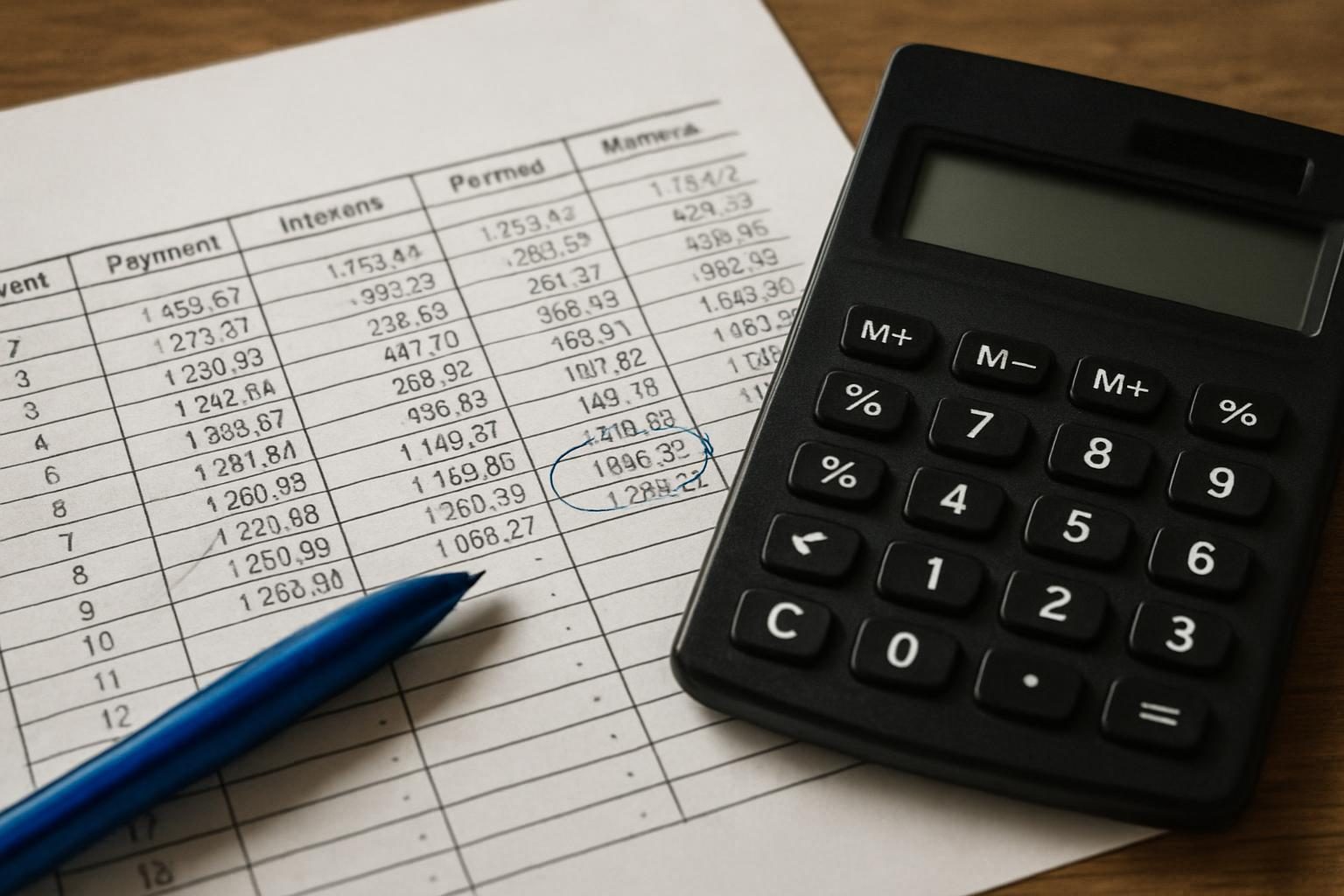
- Your regular payment: about $594 a month. Total interest over the full term is about $5,640.
- Add $50 a month ($644 total): paid off in about 55 months. Interest is about $5,110, so you save roughly $530 and finish about 5 months early.
- Add $100 a month ($694 total): paid off in about 50 months. Interest is about $4,670, so you save roughly $970 and finish about 10 months early.
Notice the pattern. Doubling the extra payment from $50 to $100 nearly doubles the interest saved. Each extra dollar does about the same work whether it arrives early or late in the loan, but earlier extra dollars have more months to compound in your favor.
Every extra dollar of principal stops earning interest for the lender from that day forward.
Example 2: $20,000 at 12% for 60 Months
Higher rates are common on used-car loans and loans for borrowers with fair credit. Here the same extra payments hit harder.
- Your regular payment: about $445 a month. Total interest over the full term is about $6,690.
- Add $50 a month ($495 total): paid off in about 52 months. Interest is about $5,750, so you save roughly $945 and finish about 8 months early.
- Add $100 a month ($545 total): paid off in about 46 months. Interest is about $5,050, so you save roughly $1,640 and finish about 14 months early.
The takeaway: at 12%, a $100 extra payment saves about $670 more than the same extra payment at 7% would, even though the loan is $10,000 smaller. If your rate is in double digits, extra payments are one of the best guaranteed returns you can get. Compare that with the simple rule for paying off debt versus investing.
Make Sure Your Extra Payment Hits Principal
This is where many people lose the benefit. Some lenders treat extra money as an early payment on the next installment, which does nothing to cut interest right away.
- Look for a “principal only” option when you pay online. Many lender portals have a separate field for it.
- Call or message your lender and ask how extra payments are applied. Get the answer in writing if you can.
- Confirm on your next statement that principal dropped by the extra amount.
- Check your contract for a prepayment penalty. They are uncommon on car loans but not unheard of. Our planned guide on car loan prepayment penalties will cover this in depth.
A few loans use precomputed interest, where the total interest is baked in upfront and early payoff saves less. If your paperwork mentions “precomputed” or the “Rule of 78,” ask your lender what you would actually save before sending extra money.
An extra payment that is not applied to principal is just a prepayment, and it may save you nothing.
Is Paying Extra the Right Move for You?
Extra car payments are a strong choice in many situations, but not all. Run through this quick checklist.
- You have higher-rate debt. If a credit card charges 22%, send extra money there first. Our debt payoff plans guide explains how to order your balances.
- You have no emergency cushion. Extra payments cannot be pulled back out. Keep at least a small starter fund first.
- You owe more than the car is worth. Paying extra helps close that gap faster. See our guide on getting out when you are upside down on a car loan.
- Your rate is high and your credit has improved. Refinancing may beat extra payments. Read about when refinancing a car loan lowers your payment and when it does not.
For the full pros-and-cons breakdown, see should you pay off your car loan early, and browse our car loan payoff guide for more strategies.
Find Your $50 or $100 and Run Your Own Numbers
You do not need a big raise to fund an extra payment. Try one or more of these:
- Round up. If your payment is $594, pay $650 every month.
- Redirect a canceled subscription or a trimmed grocery category straight to the loan.
- Run a short challenge. A 30-day no-spend challenge can free up a lump sum for one big principal payment.
- Send windfalls. Tax refunds, bonuses and side income can each shave weeks off your loan.
Then plug your own balance, APR and extra amount into our free Debt Burn-Down Calculator. If you are juggling several balances, the debt payoff calculator will show your overall debt-free date, and quick math for how long it will take to pay off your debt gives you a back-of-the-envelope estimate. If you are curious about general strategies, our planned guide on how to pay off a loan faster covers more ideas.
Before you commit extra cash, it is worth checking whether a lower rate could do more of the work. You can request free, no-obligation rate options using the form on this page, or browse ways to lower your rate first.
Frequently Asked Questions
Does an extra payment lower my monthly car payment?
No. Extra principal payments shorten the loan and reduce total interest, but your required monthly payment stays the same unless you refinance or recast the loan.
Are biweekly car payments worth it?
They can be. Paying half your payment every two weeks results in 26 half-payments a year, which equals 13 full payments instead of 12. It only works if your lender applies each payment promptly. Otherwise you can get the same effect by adding one-twelfth of a payment each month.
Should I pay extra on my car loan or my credit card?
Generally the debt with the higher interest rate comes first. Credit card APRs are often well above auto loan rates, so cards usually get priority unless the car loan rate is unusually high.
How accurate is a car loan payoff calculator?
It is accurate for fixed-rate simple-interest loans when you enter your exact balance and APR. Fees, late payments, variable rates and precomputed interest can change the result, so confirm the payoff figure with your lender.
This article is educational and not financial advice. Your results will depend on your loan terms, so consider talking with a qualified financial professional about your situation.
Get free options to lower your car loan rate
A partner will share free, no-obligation options to lower your rate so more of each payment goes to principal.