
Quick answer: A personal loan to pay off credit cards works when the loan’s all-in cost, meaning APR plus any origination fee, is meaningfully lower than your card rates, and when you stop adding new card debt. It trades revolving balances for a fixed payment and a fixed end date. It does not work if the fee eats the savings or the cards fill back up.
Key takeaways
- Compare total cost, not just the headline rate: origination fees are usually taken out of the loan before you get the money.
- The savings come from a lower APR and a fixed payoff date, not from the loan itself.
- Borrowers with strong credit often get the best offers; fair or poor credit can erase the benefit.
- The biggest risk is behavioral: paying off cards, then running them up again.
- Approval, rates and fees vary by lender and are never guaranteed.
If you are carrying several card balances at 22% or more, a personal loan to pay off credit cards can look like a clean reset. Sometimes it is. Other times it is a fee-heavy detour. The only way to know is to run the numbers before you apply.
Want to see what offers might be available to you? You can request free, no-obligation options to lower your interest rate using the form on this page.
How a Personal Loan Pays Off Credit Cards
The mechanics are simple. You borrow a lump sum from a bank, credit union or online lender, use it to pay your card balances to zero, and then repay the loan in equal monthly installments over a set term, commonly two to seven years.
- Fixed rate: Most personal loans have a rate that does not change, unlike many card APRs.
- Fixed term: You know your debt-free date on day one.
- One payment: Several due dates become one.
- Installment debt: The loan is not revolving credit, which can change how your credit utilization looks.
Some lenders send the money straight to your card issuers. Others deposit it in your account and leave the payoff to you. If you get the cash yourself, pay the cards the same day so the money does not drift.
This is a close cousin of the idea covered in our guide on whether a debt consolidation loan actually helps you pay off cards. Same tool, different angle.
APR vs Origination Fee: The $12,000 Worked Example
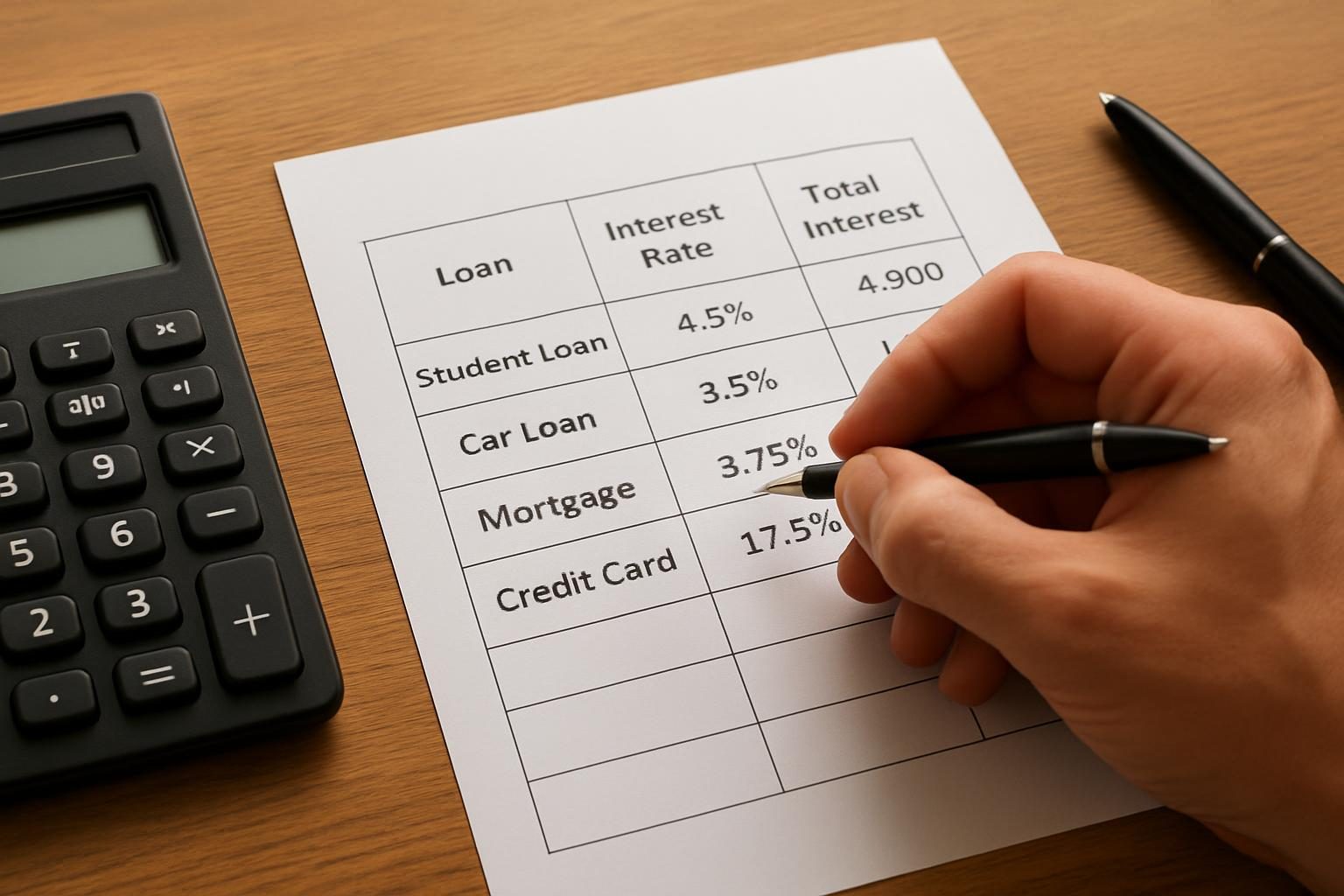
Here is where most people get tripped up. A lender may advertise a rate that looks great, then subtract an origination fee, often somewhere in the range of 1% to 8% of the loan (an estimate; it varies widely). That fee is typically deducted from your proceeds, so you borrow more than you receive.
Say you owe $12,000 across cards averaging 24% APR. Here are the assumptions, all illustrative:
- Option A, keep the cards: Pay $450 a month at 24% APR.
- Option B, loan at 14% APR, no fee: 48-month term.
- Option C, loan at 11% APR, 6% origination fee: 48-month term.
Option A: Stay on the cards
At $450 a month and 24% APR, you would pay off $12,000 in roughly 40 months, with total interest of about $5,900. Your actual numbers depend on how each card compounds and whether you add new charges.
Option B: 14% APR, no fee
Borrow $12,000 for 48 months at 14%. The payment is about $328 a month, and total interest is about $3,750. Total cost: roughly $15,750. Monthly cash flow improves by over $100.
Option C: 11% APR with a 6% fee
To receive $12,000 after a 6% fee, you must borrow about $12,765, since the fee is taken out up front. At 11% over 48 months, the payment is about $330 a month. Total interest is roughly $3,080, plus the $765 fee, for about $3,850 in total borrowing cost.
Notice what happened: the lower rate in Option C was almost completely cancelled by the fee. The two loans cost nearly the same in total.
Pro tip: Ask every lender for the APR (which includes certain fees), the origination fee, the exact amount you will receive, and the monthly payment. Then compare total repayment, not the advertised rate.
Run your own version with the Debt Burn-Down Calculator or check how long your cards would last on current payments with the credit card payoff calculator.
A lower interest rate means little if the origination fee quietly hands the savings back to the lender.
Who a Personal Loan to Pay Off Credit Cards Helps
This move tends to make sense when several of these are true:
- You have good credit. Better scores generally unlock lower rates. Terms vary by lender, and nothing is guaranteed.
- Your card APRs are high. The bigger the gap between your card rates and the loan rate, the bigger the potential savings.
- Your balance is too large for a transfer. If your debt exceeds what a 0% card will accept, a loan can cover the rest. See what to do when your debt is bigger than the limit.
- You want structure. A fixed end date helps people who lose momentum with open-ended card payments.
- Your income is stable. A fixed payment only works if you can reliably cover it.
If your credit is fair or you can pay off the balance within about 12 to 21 months, a 0% balance transfer may beat a loan. Our balance transfer fees guide shows how to weigh a 3% to 5% transfer fee (a common range) against loan costs.

Who It Does Not Help
A loan is the wrong tool in several situations:
- The rate is not much lower. If the loan APR is close to your card average, fees can make it a net loss.
- You cannot stop spending on the cards. A loan fixes the balance, not the habit.
- You are close to payoff. If you could clear the cards in a year or less, a fee-bearing loan may cost more than it saves.
- The term stretches too long. A lower payment over seven years can mean more total interest, even at a lower rate.
- Your credit is poor. Offers may come with high APRs or large fees. Look at realistic options with fair or bad credit before signing anything.
Be cautious with anything that promises approval or a rate before reviewing your information. Legitimate lenders check your credit and income first.
The Biggest Risk: Running the Cards Back Up
This is the trap that undoes the most plans. Once your cards show zero, there is a lot of room to spend. If you add new charges while also making loan payments, you now have two debts instead of one.
Ways to protect yourself:
- Remove saved cards from shopping sites and phone wallets.
- Keep one card for emergencies only and pay it in full monthly.
- Build a small starter cushion so surprise bills do not land on credit.
- Track every payment visibly. A payoff tracker or a short debt payoff challenge keeps the finish line in view.
- Do not close the old cards in a panic. Closing can affect your credit utilization and history; many people simply stop using them.
A consolidation loan fixes the math, but only a changed spending habit keeps the cards at zero.
How to Decide in Six Steps
- List every card: balance, APR and minimum payment.
- Calculate your weighted average APR. Multiply each balance by its rate, add them up, and divide by the total debt.
- Get quotes from several lenders using soft credit checks when offered, so you can compare without a hard inquiry.
- Compute total cost for each: monthly payment times months, then add any fee not already included.
- Compare against your alternatives: staying on the cards, a 0% transfer, or a snowball or avalanche plan from our debt payoff plans guide.
- Pick the shortest term you can comfortably afford. A shorter term usually means less total interest.
Also remember a hard credit inquiry can cause a small, temporary dip in your score, and opening a new loan changes your account mix and average age. Those effects are usually modest, but they are real.
Curious which option might fit you? Use the form on this page to compare free options to lower your rate, with no obligation. For more on structuring a plan, see our balance transfer vs personal loan comparison.
Frequently Asked Questions
Will a personal loan hurt my credit score?
There can be a small short-term dip from the hard inquiry and the new account. Paying off cards can lower your credit utilization, which may help over time. Results vary by person.
Is a personal loan better than a balance transfer?
It depends. A 0% transfer can be cheaper if you can pay the balance off within the promotional window. A loan can win when the balance is large, your timeline is longer, or you want a fixed payment. See our balance transfer guide for the details.
Can I pay off the loan early?
Many lenders allow it, but some charge prepayment penalties, so check the terms first. If there is no penalty, extra payments cut total interest. Our guide on whether to pay off a personal loan early covers the math.
What credit score do I need?
There is no single cutoff, and lenders set their own standards. Higher scores generally qualify for lower rates, and approval is never guaranteed. This article is educational; consider speaking with a qualified financial professional or nonprofit credit counselor about your situation.
See free options to lower your interest rate
We’ll share free, no-obligation options from partners, such as consolidation loans or 0% balance transfers, to review with no pressure.
